RESEARCH REPORT Leah Lawrence A study confirmed that PIK3CA mutations negatively affect survival in patients with HER2-positive breast cancer treated with the anti-HER2 therapy trastuzumab.
RESEARCH REPORT Anna Azvolinsky In the HERA trial, benefit for invasive lobular breast cancer patients with 1 year of trastuzumab maintenance was similar to invasive ductal carcinoma patients.
CONFERENCE REPORT Cancer Network presents exclusive coverage of the 30th Annual Miami Breast Cancer Conference. We speak with nationally recognized breast cancer specialists and bring you their insights into the optimal multidisciplinary management of patients with breast cancer and the application of innovative approaches to practice.
REVIEW ARTICLE Elgene Lim, Nancy U. Lin;ONCOLOGY Vol. 26 No. 7 This review will focus on the breast cancer subtypes with the highest incidence of breast cancer brain metastases and will characterize differences in the clinical behavior of brain metastases that arise from these different subtypes.
REVIEW ARTICLE Gunter von Minckwitz, Sibylle Loib, Michael Untch; ONCOLOGY Vol. 26 No. 1 This article provides a comprehensive summary of the knowledge gained from recent neoadjuvant trials conducted with agents targeting HER2, and will put them into perspective with the current American and European treatment guidelines.
This review explores the use of several such agents, including lapatinib (Tykerb), HSP90 inhibitors, T-DM1, and other tyrosine kinase inhibitors. Emerging data from trials of these agents indicate that the HER2 pathway remains a valid therapeutic target following disease progression on trastuzumab.
• Targeting Alternative Pathways in HER2-Positive Breast Cancer
Previous in vitro studies have suggested interactions between hyaluronan (HA), CD44 and HER2. We have studied the expression of HA and CD44 in a material of 278 breast cancer cases, half of which were HER2-positive. Intense stromal HA staining was associated with HER2 positivity, large tumor size, lymph node positivity, hormone receptor negativity, poor differentiation, a high body mass index, increased relapse rate and shortened overall survival. Among the 139 HER2-positive cases, the relapse rate was associated with the intensity of stromal HA staining as most of the relapses occurred in the cases with intense stromal HA staining. The presence of HA in the carcinoma cells was related to the frequency of relapses as none of the patients without HA in carcinoma cells experienced a relapse, whereas 33.3% of those with a high percentage of HA-positive carcinoma cells suffered a relapse. CD44 positivity in carcinoma cells was related to poor differentiation, postmenopausal status and
Dysfunction of protein kinases has been associated with the development of the various molecular subtypes of breast cancer. The best example is the known role of HER2 in the tumorigenesis of a proportion of breast tumors. In this article, we review the state of the art knowledge on protein kinases involved in breast cancer. Special attention is given to those that are potentially druggable and those for which targeted agents are currently under clinical evaluation. Options for targeted drug combinations will be discussed, as well as the optimal way to integrate new kinase inhibitors in the clinical armamentarium to fight breast cancer. We will review recent results from clinical studies with agents targeting different kinases involved in the pathophysiology of breast cancer. In addition, we will evaluate the clinical development of kinase inhibitors to identify areas of knowledge that could be explored in future preclinical and clinical studies.
Trastuzumab, in combination with chemotherapy, is the gold standard in the adjuvant treatment of patients with HER2 positive breast cancer. Limited data are available on the role of adjuvant trastuzumab in the elderly population. We performed a systematic review of prospective randomized trials with available data on the use of adjuvant trastuzumab in patients older than 60years, focusing on both the efficacy and the cardiac safety. Data extrapolated from two prospective trials were included for efficacy and cardiac safety. A significant 47% relative risk reduction was observed in elderly patients receiving trastuzumab compared to chemotherapy alone (pooled Hazard Ratio: 0.53; 95% CI, 0.36-0.77). The pooled proportion of cardiac events in elderly patients treated with trastuzumab was 5% (95% CI, 4-7%). The use of trastuzumab should be considered as a standard of care in the adjuvant therapy of elderly patients with HER-2 positive breast cancer. Acute and chronic medical conditions,
Gastric cancer remains a major health problem worldwide. Treatment of advanced gastric cancer is controversial and there is no standard regimen for first- or second-line chemotherapy (CT). This review aims to give an overview of the hot topics concerning treatment, prognostic factors and new strategies in advanced gastric cancer.|Seven questions of special clinical interest have been formulated previously to the literature review. With the aim of answering each of these questions, a specific search of the relevant trials and meta-analyses published or communicated from 1990 to date was performed.|Patients treated with CT have a survival benefit over those treated with only best supportive care (BSC). Such active cytotoxic drugs as cisplatin or docetaxel and targeted agents as trastuzumab showed superiority in randomized trials. Other agents such as oxaliplatin, oral fluoropyrimidines and irinotecan showed non-inferiority or less toxic results, positioning them as valuable alternatives
Breast cancer prognosis has improved greatly in recent years. Consequently, a thorough search for sensitive prognostic factors, able to help clinicians offer appropriate therapy, has become a priority in this area. In this study, we considered all new cases of invasive breast cancer diagnosed in the Province of Modena, Italy, between 1997 and 2007, registered by the Modena Cancer Registry. The principal endpoint of this study was relapse-free survival (RFS). A set of 11 clinic and pathological parameters was investigated. After a median follow-up of 73 months, 494 relapses were recorded. Tumor size, node status, grading, HER2 and estrogen receptor status were retained as independent factors in a multivariate analysis. Using these variables, a prognostic model was devised to identify three groups at different risk. In the training sample, the 5-year RFS rates resulted 96.0%, 82.9% and 63.7% in patients at low, intermediate and high risk, respectively (p < 0.0001). In the validation
A new study shows that drugs targeting HER2 might provide good results in the rare non-small-cell lung cancer (NSCLC) patients with HER2 mutations. More »
Genetic subtypes of disease don't explain why breast cancer is more aggressive among African-American than Caucasian women. But genotypes may explain... More »
Researchers participating in the phase III EMILIA trial have identified tumor biomarkers that can identify patients that are more likely to benefit... More »
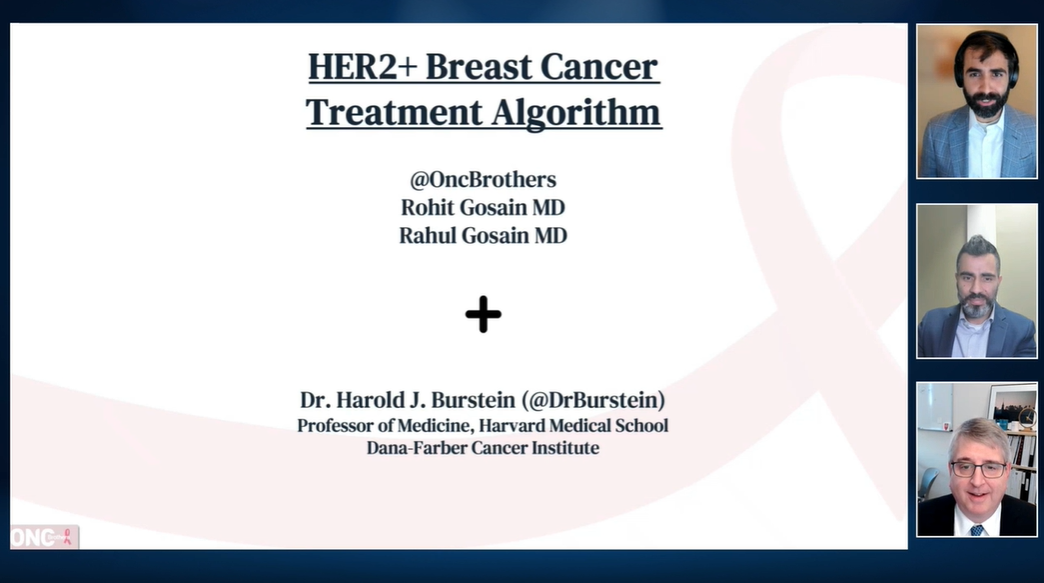
As more drugs become available in the HER2 arena, clinicians will be faced with increasing challenges regarding which sequences and combinations of... More »
Third, how much do we really know about de novo and acquired resistance to trastuzumab and lapatinib? There are several possible clinical relevant... More »
As part of our coverage for the 30th Annual Miami Breast Cancer Conference, we bring you an interview with Dr. Mark Pegram, director of the breast cancer program at the Stanford Women’s Cancer Center and codirector of the molecular therapeutics program. Dr. Pegram will be discussing the potential for novel HER2 combination therapies at the conference.
To kick off SABCS 2012, we discuss the use of molecular testing for the diagnosis and treatment of breast cancer patients in the clinical setting with Dr. Antonio Wolff of the Kimmel Cancer Center at Johns Hopkins University, one of the presenter's during the "Practical Use of Molecular Profiling" session at this year's symposium.
By history, the affected skin occasionally wept clear fluid that formed a superficial crust. With what specific disorder does the patient most likely suffer?
Key Differences between FQHCs and RHCs Chastity Werner, RHIT, June 13, 2013 FQHCs and RHCs take up a unique niche among physician practices. And that affects compensation and billing.
Improving Care Coordination in Your Practice Susanne Madden, June 12, 2013 Practices are feverishly working to control the rising costs of healthcare - effective care coordination can help.
Refunding Overpayments: Two Options for Medical Practices Ericka L. Adler, June 12, 2013 Medicare and Medicaid providers must return overpayments once identified. Here are two different refund approaches for practices to consider when necessary.
iPad Alternatives for Mobile Physicians Marisa Torrieri, June 11, 2013 As more physicians are seeing the merits of media tablets, the market is expanding, too.