RESEARCH REPORT Leah Lawrence A majority of patients with multiple myeloma are being treated with novel agents such as thalidomide, bortezomib, and lenalidomide within a year of diagnosis instead of the chemotherapeutic regimens that were more prevalent a decade ago, according to a new study.
ANNOUNCEMENT Michael Kaufman An ongoing phase III study comparing the efficacy and safety of perifosine in patients with relapsed or relapsed/refractory multiple myeloma has been discontinued.
TEST YOUR IMAGE IQ Cesar Moran, MD A 62-year-old man presented with symptoms of nasal congestion. Physical and radiographic imaging shows the presence of a nasal mass. Biopsy was performed. What is your diagnosis?
RESEARCH REPORT Leah Lawrence Multiple myeloma patients are at increased risk of developing myelodysplastic syndrome or acute leukemia after maintenance lenalidomide or thalidomide treatment, according to a new study.
PODCAST Kenneth Anderson, MD In this interview we discuss the current management and latest treatments and agents in development for multiple myeloma with Dr. Kenneth Anderson of the Dana-Farber Cancer Institute.
CONFERENCE REPORT Cancer Network presents exclusive coverage from the American Society of Hematology (ASH) annual meeting. We'll bring you onsite reports as we cover the latest research, trials, scientific advances, and controversies that are changing the way hematologic malignancies are managed and treated.
Advances in our knowledge of the molecular, cellular, and genetic bases of MM are leading to improvements in diagnosis, disease staging, and treatment—and these improvements are reflected in reduced mortality rates and lengthened survival durations.
Over the past decade, proteasomal inhibition has emerged as an important therapeutic strategy, and PIs represent a promising treatment option for the management of MM. Variations in the binding profiles of different PIs may translate into key differences in pharmacokinetic and toxicity profiles that may prove clinically relevant in the treatment of MM.
It is likely that in the near future the treatment armamentarium for MM will undergo a significant expansion as a number of these additional target pathways become validated, offering additional hope for extending survival in patients with MM.
This review will discuss the side-effect profiles of the currently approved immunomodulatory agents and bortezomib, as well as those of the newer agents, carfilzomib and pomalidomide.
This article describes the current evidence available for various treatment options as well as a personal approach to individualized therapy for relapsing patients.
The goal of this supplement is to present a comprehensive overview of the major current and emerging treatment options for patients with relapsed and/or refractory MM, with particular focus on proteasome inhibitors and immunomodulatory drugs, along with other emerging agents (eg, histone deacetylase inhibitors, heat shock protein inhibitors, and monoclonal antibodies).
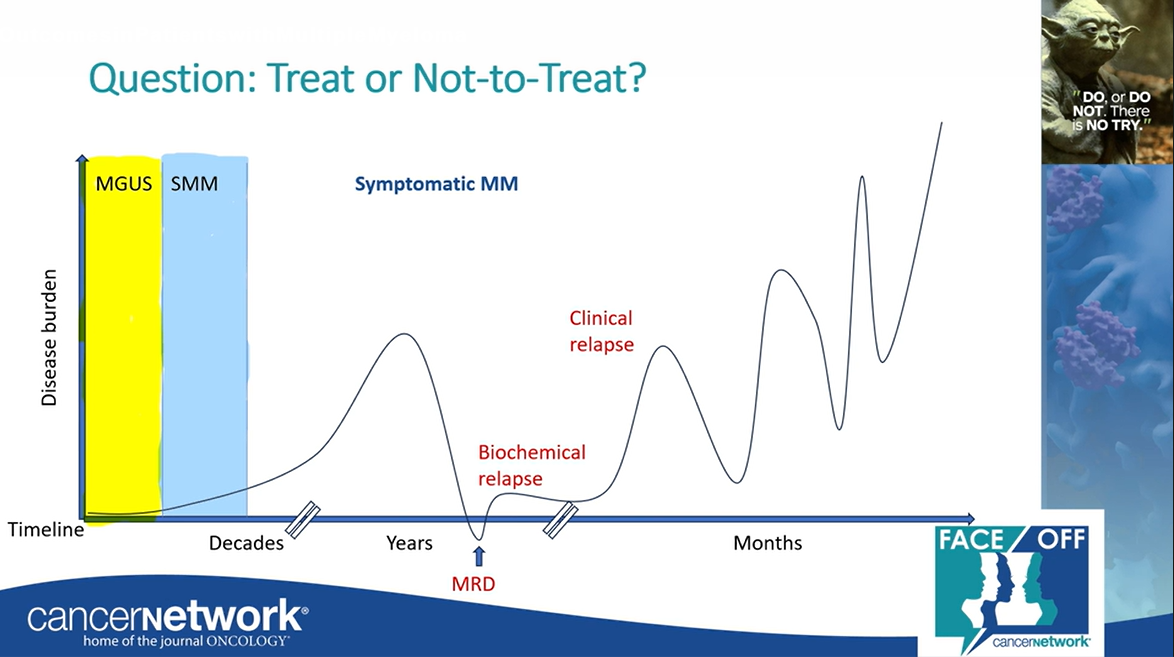
The overall risk of progression to a malignant condition is 10% per year for the first 5 years, approximately 3% per year for the next 5 years, and 1% to 2% per year for the following 10 years. Patients with both MGUS and SMM must be followed up for their lifetime.
• Multiple Myeloma Precursor Disease • MGUS and Smoldering Myeloma
At the opening session of ASCO 2011, Dr. Kenneth C. Anderson, the Kraft Family Professor of Medicine at Harvard Medical School and Director of the LeBow Institute for Myeloma Therapeutics and Jerome Lipper Center for Multiple Myeloma at the Dana-Farber Cancer Institute, was awarded ASCO’s highest award—the David A. Karnofsky Memorial Award, which recognizes outstanding achievement in cancer research. Dr. Anderson was honored for his accomplishments in three decades of research in the field of multiple myeloma.

Wogonin is one of the major constituents derived from Scutellaria Baicalensis, which has been reported to inhibit cell growth and/or induce apoptosis in various cancer cell lines. We aim to investigate the anticancer effects and associated mechanisms of wogonin on human multiplemyeloma cell line in vitro.|Effects of wogonin on the proliferation, cell cycle progression, and apoptosis of human myeloma cells were examined in vitro. The proteins associated with the biological effects of wogonin were analyzed by immunoblotting and immunocytochemical staining. In addition, the binding mode of wogonin within crystal structure of Akt1 protein was also evaluated by molecular docking analysis using the CDOCKER algorithm in Discovery Studio.|Myeloma cell growth was attenuated by wogonin (70.4-352.0 M) in a concentration-dependent manner. Cell cycle progression analysis and TUNEL assay showed that apoptosis was enhanced in wogonin-treated cells. Increased apoptosis was accompanied by decreased
Newer systemic therapies have significantly advanced the treatment of multiplemyeloma, but additional agents are needed. Bortezomib is a proteasome inhibitor with efficacy in relapsed/refractory multiplemyeloma that inhibits tumor angiogenesis, a process that has been implicated in multiplemyeloma pathogenesis.|In AMBER("A Randomized, Blinded, Placebo-Controlled, Multicenter, Phase II Study of Bevacizumab in Combination With Bortezomib in Patients With Relapsed or Refractory MultipleMyeloma"), patients with relapsed or refractory multiplemyeloma were randomized to receive bortezomib (1.3 mg/m(2) on days 1, 4, 8, and 11 of each 21-day cycle) and either placebo or bevacizumab (15 mg/kg on day 1 of each cycle) for up to 8 cycles. At completion, patients in the bortezomib-plus-bevacizumab arm could continue bevacizumab until they developed progressive disease or unacceptable toxicity. The primary endpoint was progression-free survival (PFS).|The stratified hazard ratio of PFS for the
Recently, we showed that increased miR-181a expression was associated with improved outcomes in cytogenetically normal acute myeloid leukemia (CN-AML). Interestingly, miR-181a expression was increased in CN-AML patients harboring CEBPA mutations, which are usually biallelic and associate with better prognosis. CEBPA encodes the C/EBP transcription factor. We demonstrate here that the presence of N-terminal CEBPA mutations and miR-181a expression are linked. Indeed, the truncated C/EBP-p30 isoform, which is produced from the N-terminal mutant CEBPA gene or from the differential translation of wild-type CEBPA mRNA and is commonly believed to have no transactivation activity, binds to the miR-181a-1 promoter and up-regulates the microRNA expression. Furthermore, we show that lenalidomide, a drug approved for myelodysplastic syndromes and multiplemyeloma, enhances translation of the C/EBP-p30 isoform, resulting in higher miR-181a levels. In xenograft mouse models, ectopic miR-181a
We conducted a retrospective study to compare thalidomide, bortezomib and dexamethasone (VTD) with thalidomide plus doxorubicin and dexamethasone (TAD). Until now, first-line treatment with these combinations has not been reported in any comparative study. The principal objective of this study was to determine whether VTD would improve the complete response (CR) and CR plus very good partial response rates compared with TAD. Second, using additional methods, such as flow cytometric assays and polymerase chain reaction technology, we evaluated the molecular residual disease in the subgroup of patients that obtained CR. Our study shows that VTD is a superior induction regimen compared with TAD, with a higher response rate after induction, translating into greater CR plus very good partial response.
The Tel2 (also known as Telo2) and Tti1 proteins control the cellular abundance of mammalian PIKKs and are integral components of mTORC1 and mTORC2. Here we report that Tel2 and Tti1 are targeted for degradation within mTORC1 by the SCFFbxo9 ubiquitin ligase to adjust mTOR signalling to growth factor availability. This process is primed by CK2, which translocates to the cytoplasm to mediate mTORC1-specific phosphorylation of Tel2/Tti1, subsequent to growth factor deprivation. As a consequence, mTORC1 is inactivated to restrain cell growth and protein translation whereas relief of feedback inhibition activates the PI(3)K/TORC2/Akt pathway to sustain survival. Significantly, primary human multiple myelomas exhibit high levels of Fbxo9. In this setting, PI(3)K/TORC2/Akt signalling and survival of multiplemyeloma cells is dependent on Fbxo9 expression. Thus, mTORC1-specific degradation of the Tel2 and Tti1 proteins represents a central mTOR regulatory mechanism with implications in
Multiple myeloma patients are at increased risk of developing myelodysplastic syndrome or acute leukemia after maintenance lenalidomide or thalidomide... More »
A majority of patients with multiple myeloma are being treated with novel agents such as thalidomide, bortezomib, and lenalidomide within a year of... More »
An ongoing phase III study comparing the efficacy and safety of perifosine in patients with relapsed or relapsed/refractory multiple myeloma has been... More »
African American men with multiple myeloma had a significantly lower frequency of IgH translocations, a signal of nonhyperdiploid multiple myeloma,... More »
The FDA has approved pomalidomide (Pomalyst) to treat patients with relapsed or refractory multiple myeloma who have received at least two prior... More »
In this interview we discuss the current management and latest treatments and agents in development for multiple myeloma with Dr. Kenneth Anderson of the Dana-Farber Cancer Institute.
A 62-year-old man presented with symptoms of nasal congestion. Physical and radiographic imaging shows the presence of a nasal mass. Biopsy was performed. What is your diagnosis?
Five Steps to Improving Patient Access Judy Capko, May 21, 2013 Patient access is getting increased attention through reform initiatives. Here are five steps you can take to make sure patients get appropriate access to care in your office.
Growing HIPAA Threat – Ignore Windows XP at Your Own Peril Marion K. Jenkins, May 21, 2013 Chances are good that you have some major ticking software time bombs lurking in your medical practice's computer environment, namely Windows XP and Server 2003.
Three Areas to Reduce Costs at Your Medical Practice Greg Mertz, May 19, 2013 By taking a hard look at reducing costs for staffing, overhead, and technology at your medical practice, you may see increased physician compensation.
Dos and Don’ts for Starting a Physician Blog Michael Woo-Ming, MD, May 18, 2013 Starting a physician blog can provide your medical practice with marketing benefits, but it's important to do it right.