




Gastrointestinal Cancer
Latest News
Advertisement
Latest Videos






CME Content































Advertisement
More News

Advances in perioperative targeted therapies may enable organ preservation and significantly enhance outcomes for patients with gastric cancers.
Phase 3 data support ramucirumab/paclitaxel switch maintenance as a post-induction therapy for patients who are not eligible for immunotherapy.

Results from the CheckMate649 trial support the use of nivolumab plus chemotherapy in the treatment of advanced gastric cancers.
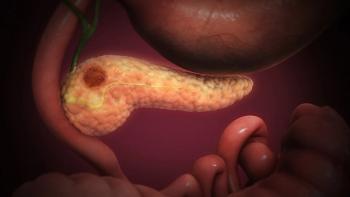
The OSE2101 cancer vaccine plus FOLFIRI chemotherapy demonstrated positive survival data with minimal toxicities in the phase 2 TEDOPaM trial.
James Zoeller discussed various aspects of his cancer care after a RCC diagnosis with Hannah D. McManus, MD, and Allison Brown, BSN, RN, RN-BC.

Data from the MATTERHORN trial show a trend towards improved overall survival with the durvalumab combination in gastric and GEJ cancers.
The CheckMate 9DW trial found that nivolumab and ipilimumab elicited a median OS of 23.7 months compared with 20.6 months from lenvatinib or sorafenib.
Perioperative and adjuvant S-1 and oxaliplatin demonstrated consistent OS and DFS benefits over adjuvant capecitabine and oxaliplatin.
In the phase 3 COMPETE trial, ITM-11 met its primary end point of PFS and showed a favorable trend with respect to OS in GEP-NETs.
The safety profile of trastuzumab deruxtecan in the phase 3 DESTINY-Gastric04 trial was consistent with the established safety profile of the agent.

Data from the RATIONALE-306 trial support the approval of tislelizumab plus chemotherapy in unresectable or metastatic esophageal squamous cell carcinoma.

Antitumor efficacy end points favored placebo over trilaciclib prior to FOLFOXIRI/bevacizumab in patients with untreated metastatic colorectal cancer.
In a small cohort of patients with MMS/pMMR CRC, the suvemcitug and envafolimab pharmacokinetic profiles were comparable with prior monotherapy studies.
The CAN-2409 combination improved survival post-progression vs standard-of-care therapy alone in the phase 2 PaTK02 trial.
Phase 3 CheckMate-8HW trial results evaluating the combination in microsatellite instability–high or mismatch repair deficient CRC supported the decision.

The approval of sotorasib plus panitumumab is a “welcome step” in KRAS G12C-mutated colorectal cancer, according to Marwan G. Fakih, MD.

Combining sotorasib with panitumumab may reduce the burden of disease in patients with KRAS G12C-mutated metastatic colorectal cancer.
Findings from the CodeBreak 300 study have cemented sotorasib/panitumumab as a third-line treatment option for KRAS G12C-mutated colorectal cancer.

Adding panitumumab to sotorasib has yielded higher responses rates in KRAS G12C-mutated CRC compared with prior standards of care.
Sotorasib plus panitumumab may offer improved survival compared with previously approved treatment options in KRAS G12C-mutated colorectal cancer.
Additional local, regional, or national policy may bolster access to screening for colorectal cancer, according to Aasma Shaukat, MD, MPH.
There were fewer adverse effects and no treatment-related deaths associated with thermal ablation vs surgical resection for patients with colorectal liver metastases.
Findings from the CheckMate 9DW trial support the CHMP’s recommendation for approving nivolumab/ipilimumab for those with unresectable HCC.
The mechanism of action for daraxonrasib inhibits effectors and signaling while forming a relatively unstable tri-complex with codon 12 mutations.
Almost all patients evaluable for efficacy reported a decrease in ctDNA when treated with daraxonrasib for RAS-mutant pancreatic ductal adenocarcinoma.
Advertisement
Advertisement
Trending on CancerNetwork
1
Modifiable Risk Factors Suggest Potential for Improving Cancer Prevention
2
Barriers to CAR T-Cell Referral and Center Access in Multiple Myeloma
3
2026 Tandem Meetings: What’s the Latest Research in Multiple Myeloma?
4
Real World Outcomes of CAR T-Cell Therapy in Multiple Myeloma Including Older and Comorbid Patients
5