






Non-Small Cell Lung Cancer (NSCLC)
Latest News
Advertisement
Latest Videos



CME Content
































Advertisement
More News

Misako Nagasaka, MD, PhD, and Kristen Neumann, DNP, FNP-C, emphasize the importance of patient education, discussing how understanding the biological reasons behind treatments for EGFR-mutated non-small cell lung cancer and their side effects can lead to better outcomes, and highlighting the need for collaborative care and clear communication.

Data from the phase 3 KEYNOTE-091 trial supported the European Commission’s approval of pembrolizumab as an adjuvant treatment for adults with non–small cell lung cancer at high risk of recurrence following complete resection and platinum-based chemotherapy.

Amivantamab plus chemotherapy may be the new standard of care for patients with EGFR-mutated advanced non–small cell lung cancer that has progressed following osimertinib, according to Antonio Passaro, MD, PhD.

Objective response rate appears to be higher with datopotamab deruxtecan compared with docetaxel among patients with advanced or metastatic non–small cell lung cancer in the phase 3 TROPION-Lung01 study.

Amivantamab plus lazertinib may represent a new standard of care in those with EGFR-mutated advanced non–small cell lung cancer, according to Byoung Chul Cho, MD, PhD.
Misako Nagasaka, MD, PhD, and Kristen Neumann, DNP, FNP-C, discuss the importance of early dermatological consultations and multidisciplinary education for managing infusion-related adverse events like rashes from amivantamab, emphasizing the benefits of a well-coordinated team and the value of experience in responding to reactions.

Kristen Neumann, DNP, FNP-C, emphasizes the efficacy of the drug amivantamab for patients with EGFR exon 20 mutations, explaining the challenges of unique skin rashes, but highlighting the importance of teamwork in effectively managing and treating these adverse skin effects.

Amivantimab produces superior progression-free survival in EGFR exon 20 insertion–positive non–small-cell lung cancer.

Patients with RET fusion–positive non–small cell lung cancer experienced improved progression-free survival with first-line selpercatinib.
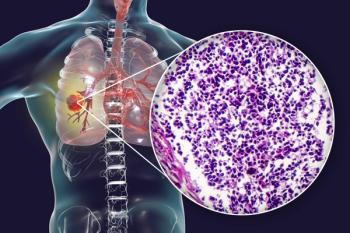
Alectinib improves disease-free survival in patients with ALK-positive non–small-cell lung cancer.

Central nervous system progression was reduced with osimertinib plus chemotherapy for patients with EGFR-mutated non-small cell lung cancer plus CNS metastases.

Neoadjuvant nivolumab combination followed by surgery and adjuvant nivolumab show an improvement in event-free survival for patients with previously untreated resectable stage II to IIIB non-small cell lung cancer.
Results from the phase 2 PERLA trial showed an improved objective response and overall survival in treatment with dostarlimab plus chemotherapy in patients with treatment-naïve, nonsquamous non–small cell lung cancer.

Data from the phase 2 KRYSTAL-7 study support a phase 3 trial assessing concurrent adagrasib plus pembrolizumab compared with pembrolizumab alone in treatment-naïve KRAS G12C-mutated non–small cell lung cancer.
Data from a phase 1a/1b trial support additional research on dual TIGIT/PD-L1 inhibition in patients with advanced solid tumors.

The FDA companion diagnostic designation for the FoundationOne CDx and FoundationOne Liquid CDx may improve access to treatment with encorafenib plus binimetinib for those with BRAF V600E-mutated non–small cell lung cancer.

Those with resectable non–small cell lung cancer can now receive neoadjuvant treatment with pembrolizumab and chemotherapy followed by adjuvant pembrolizumab after approval by the FDA.

Results from the phase 3 FLAURA2 trial allowed for the combination of osimertinib plus chemotherapy to be submitted for priority review.
Multidisciplinary Management of Treatment-Related Adverse Events in Patients With EGFR-Mutated NSCLC
Kristen Neumann, DNP, FNP-C, highlights the value of a multidisciplinary approach in the care of patients with EGFR-mutated non-small cell lung cancer, emphasizing the roles of dermatologists, pharmacists, and nurses in ensuring thorough patient assessment and education; Misako Nagasaka, MD, PhD, highlights data from WCLC 2023 on osimertinib in EGFR-mutated NSCLC.
Kristen Neumann, DNP, FNP-C, emphasizes the importance of early assessment and potential dose reductions or holds when patients on treatment for EGFR-mutated non-small cell lung cancer show adverse effects, while Misako Nagasaka, MD, PhD, stresses the need for accurate symptom history and supporting lab work to ensure patient safety.
Patients diagnosed with BRAF V600E–mutant, metastatic non–small cell lung cancer are now able to undergo treatment with combination encorafenib and binimetinib.

Investigators plan to share data from the phase 3 KEYNOTE-671 trial assessing perioperative pembrolizumab in resectable non–small cell lung cancer with international regulatory health authorities.
Kristen Neumann, DNP, FNP-C, and Misako Nagasaka, MD, PhD, discuss the importance of patient education on diarrhea as a side effect of EGFR-mutated non-small cell lung cancer treatment, emphasizing dietary considerations and the use of over-the-counter remedies.
Misako Nagasaka, MD, PhD, and Kristen Neumann, DNP, FNP-C, a family nurse practitioner with 30 years of experience in oncology, discuss EGFR-mutated non-small cell lung cancer, the available treatment options, and common side effects such as rash, emphasizing patient education and proactive management for side effects.
Members of the committee reviewed findings from the phase 3 CodeBreaK200 trial, assessing the benefit of sotorasib in KRAS G12C–mutant non–small cell lung cancer.
Advertisement
Advertisement
Trending on CancerNetwork
1
Modifiable Risk Factors Suggest Potential for Improving Cancer Prevention
2
2026 Tandem Meetings: What’s the Latest Research in Multiple Myeloma?
3
Dato-DXd Receives Priority Review in Unresectable/Metastatic TNBC
4
Barriers to CAR T-Cell Referral and Center Access in Multiple Myeloma
5