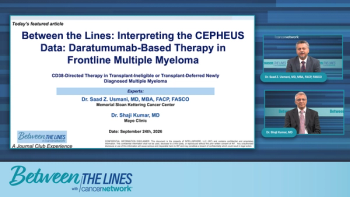
Dr. Saad Usmani and Dr. Shaji Kumar conclude the discussion by considering how the CEPHEUS findings may be applied to individual patients with newly diagnosed multiple myeloma.
Dr. Saad Usmani and Dr. Shaji Kumar conclude the discussion by considering how the CEPHEUS findings may be applied to individual patients with newly diagnosed multiple myeloma.
Dr. Saad Usmani and Dr. Shaji Kumar discuss how sustained MRD negativity and long-term progression-free survival may inform future treatment strategies for patients with newly diagnosed multiple myeloma.
Dr. Saad Usmani and Dr. Shaji Kumar examine the CEPHEUS findings on response depth and durability in newly diagnosed multiple myeloma, with particular emphasis on MRD negativity and its potential implications for treatment duration.
Dr. Saad Usmani reviews the design of the phase 3 CEPHEUS study in patients with transplant-ineligible or transplant-deferred newly diagnosed multiple myeloma, highlighting the importance of patient fitness and age in defining the study population.
Dr. Saad Usmani and Dr. Shaji Kumar discuss how treatment goals and measures of clinical benefit have evolved in newly diagnosed multiple myeloma.
Dr. Saad Usmani and Dr. Shaji Kumar introduce the evolving treatment landscape for newly diagnosed multiple myeloma, focusing on the increasing role of CD38-directed therapy in frontline treatment.
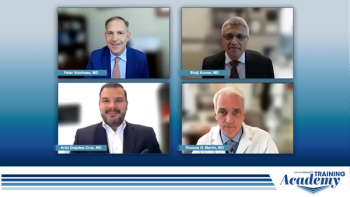
Experts on multiple myeloma outline current challenges in determining the optimal treatment strategy for patients with relapsed/refractory disease who are eligible for bispecifics and CAR T-cell therapy.
The panel concludes its discussion with key takeaways on unmet needs and evolving treatment paradigms in relapsed/refractory multiple myeloma.
Experts on multiple myeloma outline current challenges in determining the optimal treatment strategy for patients with relapsed/refractory disease who are eligible for bispecifics and CAR T-cell therapy.
Shaji Kumar, MD, reviews data from cohort C of CARTITUDE-2 and a real-world study evaluating ide-cel in patients with relapsed/refractory multiple myeloma.
Following the presentation of a case of a patient with relapsed/refractory multiple myeloma, the expert panel reviews treatment options.
Shaji Kumar, MD, reviews data from cohort C of CARTITUDE-2 and a real-world study evaluating ide-cel in patients with relapsed/refractory multiple myeloma.
The panel discusses how they approach treatment selection and sequencing for patients with relapsed/refractory multiple myeloma.
Shaji Kumar, MD, presents the case of a 70-year-old patient with relapsed/refractory multiple myeloma who received CAR T-cell therapy.
Thomas G. Martin, MD, reviews findings from a pooled analysis from MagnetisMM that evaluated elranatamab in patients with relapsed/refractory MM who received prior BCMA-directed therapies.
Focusing on treatment paradigms for patients with relapsed/refractory multiple myeloma, the expert panel discusses the role of BCMA-targeted bispecifics and how they might consider sequencing therapies.
Following the presentation of a case of a patient with multiple myeloma, the panel have a roundtable discussion on how to approach treatment.
A panel of myeloma specialists review the case of a 67-year-old patient with multiple myeloma (MM) who received a bispecific antibody.
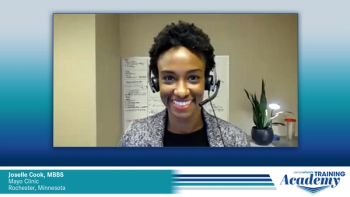
Closing out their panel on bispecifics in relapsed/refractory multiple myeloma, key opinion leaders share closing thoughts and hopes for the future treatment landscape.
Expert panelists from Mayo Clinic discuss their approach for the use of BCMA and non-BCMA targeting bispecifics, respectively, in patients with relapsed/refractory multiple myeloma.
Focused discussion on the mSMART guidelines for monitoring and managing adverse events associated with bispecific therapies in patients being treated for relapsed/refractory multiple myeloma.
A panel of key opinion leaders from Mayo Clinic reflect on optimizing use of bispecifics in relapsed/refractory multiple myeloma, reviewing step-up dosing, administration, and followup strategies.
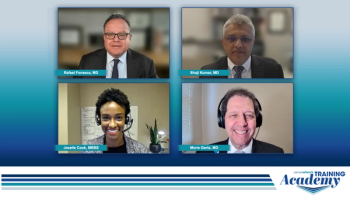
Comprehensive insights from experts in Mayo Clinic on the selection and sequencing of CAR T cell therapy or bispecifics, respectively, in patients with relapsed/refractory multiple myeloma.
Before closing out the panel’s review of clinical data behind bispecifics in relapsed/refractory multiple myeloma, Morie Gertz, MD, highlights use of cevostamab therapy in this setting.
Shared insight from Rafael Fonseca, MD, on data from MonumenTAL-1 and the use of talquetamab therapy in patients with relapsed/refractory multiple myeloma.
Expert perspectives from Joselle Cook, MBBS, on use of elranatamab in relapsed/refractory multiple myeloma based on data from the MagnetisMM-1 trial.
Expert Shaji Kumar, MD, spearheads a review of data from MajesTEC-1 and use of teclistamab therapy in patients with relapsed/refractory multiple myeloma.
Opening the panel’s discussion on multiple myeloma management, Rafael Fonseca, MD, reviews treatment options available to patients at early or late relapse.
The panel closes their discussion with a look at an ongoing clinical trial in transplant-ineligible NDMM.
Dr Sandy Wong reviews data from a patient subgroup analysis of the MAIA trial in transplant-ineligible NDMM.
June 13th 2023