Between the Lines


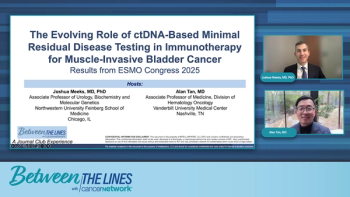
Experts discuss recent advances in circulating tumor DNA (ctDNA) testing for muscle-invasive bladder cancer (MIBC), highlighting findings from three key ESMO 2025 studies, CheckMate 274, SunRISe-4, and IMvigor011, and emphasizing the growing role of ctDNA in identifying high-risk patients and guiding more personalized treatment strategies.

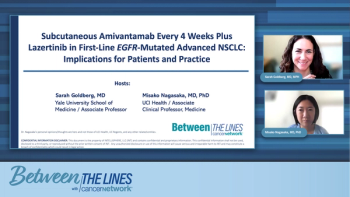
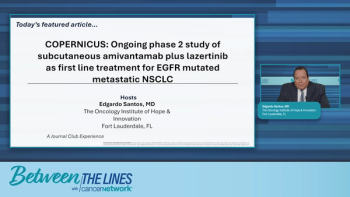
The MARIPOSA update series explores the evolving treatment landscape for EGFR-mutant non–small cell lung cancer (NSCLC), highlighting how the amivantamab plus lazertinib combination outperforms osimertinib as a first-line therapy. Through updated analyses from ESMO 2025, it demonstrates that this dual EGFR-MET targeting approach significantly reduces mechanisms of acquired resistance—especially MET amplification and secondary EGFR mutations —resulting in longer progression-free and overall survival. The findings reinforce the biologic rationale for early combination therapy, reduced mutational heterogeneity, and the potential to reshape long-term outcomes for patients with EGFR-mutant NSCLC

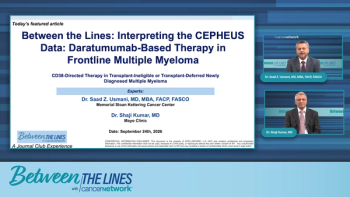
Panelists discuss how emerging data and guidelines reinforce quadruplet therapy as the foundation of NDMM treatment, supported by the ADVANCE trial’s findings on efficacy, safety, and applicability across risk groups. They highlight how precision testing, risk assessment, and evolving biologic therapies continue to refine individualized patient care.

Experts discuss the evolving landscape of relapsed or refractory multiple myeloma treatment, highlighting the transformative role of T-cell–redirecting therapies, such as bispecific antibodies and chimeric antigen T cells, while emphasizing the importance of innovative approaches, optimized sequencing, toxicity management, and expanded access—particularly through outpatient and hybrid care models in community settings—to ensure safe, effective, and convenient treatment across diverse patient populations.

Experts discuss the critical advancements in biomarker-driven frontline treatment for high-risk chronic lymphocytic leukemia (CLL), emphasizing the SEQUOIA trial’s evidence supporting targeted Bruton tyrosine kinase inhibitor monotherapy and combination therapies with venetoclax as effective, personalized, and well-tolerated options that improve progression-free survival and patient quality of life.

Panelists discuss how proactive dermatologic management using the protocol from the COCOON randomized, controlled trial (RCT) can significantly reduce grade 2 or higher skin-related adverse events from 73% to 41% in EGFR-mutated non–small cell lung cancer patients treated with amivantamab, emphasizing the shift from reactive to preventive care strategies to improve quality of life and treatment adherence.

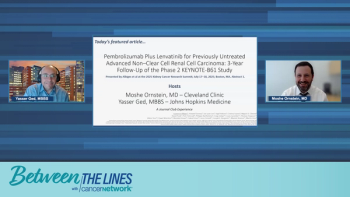
Panelists discuss how the 3-year follow-up data from the KEYNOTE-B61 study demonstrate that pembrolizumab plus lenvatinib represents a new standard of care for advanced non–clear cell renal cell carcinoma (RCC), achieving impressive response rates of approximately 51%, median progression-free survival of 17.9 months, and median overall survival of 41.5 months across various histological subtypes, including papillary, chromophobe, translocation, and unclassified RCC.

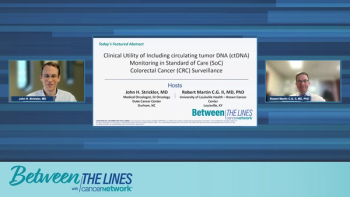
Experts discuss how multidisciplinary care, pathology review, surgical quality, and circulating tumor DNA (ctDNA) testing together personalize colorectal cancer surveillance and treatment, improving early detection, guiding therapy decisions, reducing patient anxiety, and enhancing long-term outcomes across diverse clinical settings.

Panelists discuss how 5-year follow-up data from the CARTITUDE-1 study demonstrate that chimeric antigen receptor T-cell therapy with ciltacabtagene autoleucel achieved durable remissions in heavily pretreated patients with multiple myeloma, with 30% remaining progression free at 5 years and some patients achieving what may be considered a functional cure, potentially transforming multiple myeloma from an incurable to a curable disease.

Mazyar Shadman, MD, MPH, and Sayeef Mirza, MD, MPH, FACP, discuss how real-world data from over 1500 patients demonstrates that CAR T-cell therapy (CAR T) toxicities like cytokine release syndrome and neurotoxicity occur predominantly within the first 2 weeks post infusion, supporting the potential for reduced monitoring requirements and improved patient access to these lifesaving treatments.

Panelists discuss how CD38 antibody–based four-drug regimens are transforming frontline multiple myeloma treatment by improving efficacy, deepening and sustaining MRD responses, and expanding use across patient populations through individualized dosing—establishing a new standard of care while paving the way for integration of novel immunotherapies and potential shifts in transplant strategy.

Binod Dhakal, MD; and Leonid Shunyakov, MD, discuss how talquetamab (targeting GPRC5D) represents a breakthrough therapy for patients with relapsed/refractory multiple myeloma, demonstrating unprecedented 3-year overall survival rates of 45% to 61% with lower infection risks compared with BCMA-directed therapies, while addressing optimal sequencing strategies, outpatient management approaches, and the potential for earlier-line usage to maximize patient outcomes.

Alexander Spira, MD, PhD, FACP, FASCO, and Randi Rabin, MPH, MSc, PA-C, discuss how proactive dermatologic adverse event management—specifically through the COCOON protocol—enhances treatment adherence, reduces toxicity, and improves quality of life for patients with EGFR-mutant non–small cell lung cancer receiving amivantamab plus lazertinib.

Martin Dietrich, MD, PhD and Roy Herbst, MD discuss how the evolving first-line treatment options for EGFR-mutated non-small cell lung cancer, including osimertinib monotherapy, osimertinib plus chemotherapy, and amivantamab plus lazertinib, have reshaped the landscape, with a strong emphasis on overall survival benefits and the role of combination therapies in improving patient outcomes.

John Marshall, MD, and Mark Lewis, MD, discuss how circulating tumor DNA (ctDNA) testing in colorectal cancer offers promising clinical utility across the care continuum, from early detection to treatment monitoring, with trials like BESPOKE and SWOG 80702 demonstrating its potential to guide personalized therapy decisions, predict outcomes based on minimal residual disease status, complement traditional imaging in challenging cases, and transform patient care through a patient-centric approach that requires ongoing research to establish standardized protocols.

Experts discuss the analyses on the impact of tumor burden at progression and changes in IMDC risk scores in the CLEAR trial, providing prognostic insights in advanced RCC with lenvatinib plus pembrolizumab.

Experts discuss the 3-year follow-up results from the phase 3 TRANSFORM study, comparing liso-cel with standard of care with salvage chemotherapy followed by autologous stem cell transplant (ASCT) as second-line treatment in patients with relapsed/refractory large B-cell lymphoma (R/R LBCL).

David Ilson, MD, PhD; Sunnie Kim, MD; and Raji Shameem, MD, discuss how first-line nivolumab plus chemotherapy has demonstrated sustained survival benefits in advanced gastric cancer, with PD-L1 combined positive scores helping guide patient selection. Long-term safety data support its role as standard of care, particularly benefiting patients with PD-L1–high disease, though unmet needs remain in subgroups with PD-L1–low disease.

Joshua K. Sabari, MD, and Martin Dietrich, MD, PhD, examine both the evolution of first-line EGFR TKIs as standard treatment for EGFR-mutated metastatic non-small cell lung cancer and the ongoing clinical challenges in managing resistance, toxicities, and treatment sequencing in this space.

Panelists discuss how the CLEAR trial highlights the efficacy of lenvatinib plus pembrolizumab over sunitinib in advanced renal cell carcinoma, focusing on patterns of progression and the implications for subsequent therapy.

Panelists discuss how nivolumab plus relatlimab may offer a similar efficacy to nivolumab plus ipilimumab in advanced melanoma, with a potentially better safety profile, based on an indirect treatment comparison using data from the RELATIVITY-047 and CheckMate 067 trials.

Mike J. Pishvaian, MD, PhD; Stacey Cohen, MD; and Mark Lewis, MD, FASCO, discuss how recent advancements in circulating tumor DNA (ctDNA) and minimal residual disease (MRD) testing are revolutionizing colorectal cancer management across the care continuum, from early detection to treatment selection and monitoring, with key insights from major clinical trials like DYNAMIC and GALAXY informing more personalized and effective treatment strategies.

Panelists discuss how the CARTITUDE-4 study data highlights the significant survival benefits of ciltacabtagene autoleucel compared to with standard of care in patients with lenalidomide-refractory multiple myeloma, emphasizing its potential to reshape treatment paradigms in this challenging population.

Panelists discuss managing infusion-related reactions with amivantamab and lazertinib, compare these reactions with those from other treatments, and review SKIPPirr data to provide insights on incorporating prophylactic dexamethasone 8 mg, addressing implementation barriers, and educating patients.

Panelists discuss insights from the MARIPOSA study on first-line treatment options for EGFR-mutant metastatic non–small cell lung cancer (NSCLC), highlighting the efficacy of amivantamab-lazertinib over osimertinib, the importance of managing adverse events, adherence to National Comprehensive Cancer Network guidelines, and the need for patient engagement in treatment discussions to address unmet needs.

Panelists discuss how myelofibrosis management involves a blend of medications, supportive care, and potential stem cell transplantation, with a focus on Janus kinase inhibitors and investigational agents like pelabresib for modifying disease progression, as well as the findings from the MANIFEST-2 trial regarding spleen volume reduction and biomarker data.

Larysa Sanchez, MD; and Samantha Shenoy, MSN, NP, discuss the management of adverse events with bispecific antibodies like GPRC5D and talquetamab while providing guidance on optimizing treatment outcomes and supportive care, as well as offering advice for managing toxicities and future perspectives on relapsed/refractory multiple myeloma.

Rahul Gosain, MD; Rohit Gosain, MD, and Daniel Ahn, DO, analyze pivotal studies in hepatocellular carcinoma, including HIMALAYA, IMbrave 150, and CheckMate 9DW, discussing study designs, outcomes, patient characteristics, and efficacy data.