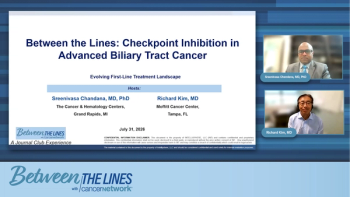
Dr. Mazyar Shadman from Fred Hutchinson Cancer Center and Dr. Andrew Lipsky from Columbia University discuss the evolving first-line treatment landscape for chronic lymphocytic leukemia (CLL) in the era of BTK inhibition.
The program covers two major therapeutic strategies: continuous therapy with second-generation covalent BTK inhibitors (zanubrutinib or acalabrutinib) and time-limited venetoclax-based combinations including venetoclax-obinutuzumab, acalabrutinib-venetoclax, or zanubrutinib-venetoclax. Key biomarkers including TP53 aberrations and IGHV mutational status inform treatment selection, with TP53 aberrations favoring continuous BTK inhibitor therapy.
Highlighted data includes 78-month SEQUOIA follow-up showing 74% progression-free survival at 6 years for zanubrutinib monotherapy, pirtobrutinib's emerging frontline and sequencing data, and real-world evidence supporting treatment selection. The discussion addresses MRD testing utility, elderly patient management, and treatment sequencing after progression. Two clinical cases illustrate individualized decision-making incorporating molecular risk factors, comorbidities, disease burden, and patient preferences.