
News|Videos|July 5, 2026
How CELMoDs’ Milder GI AEs May Reduce Discontinuation Rates in Multiple Myeloma
Author(s)Paul G. Richardson, MD, Muhamed Baljevic, MD
Muhamed Baljevic, MD, FACP, and Paul Richardson, MD, discuss how sparing patients from IMiD-related GI toxicity and neutropenic infections with CELMoDs may extend treatment duration and progression-free survival.
Advertisement
Episodes in this series
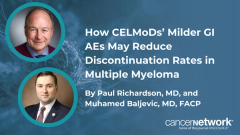
Muhamed Baljevic, MD, FACP, associate professor of medicine and Director of Plasma Cell Disorders Research at Vanderbilt-Ingram Cancer Center, and Paul Richardson, MD, director of Clinical Research and Clinical Program Leader at the Jerome Lipper Multiple Myeloma Center at Dana-Farber Cancer Institute, discuss how CELMoDs such as mezigdomide appear to spare patients from the long-term gastrointestinal (GI) toxicity associated with immunomodulatory drugs (IMiDs) like lenalidomide (Revlimid) and pomalidomide (Pomalyst). They explain how improved tolerability could keep patients on therapy longer and translate into better progression-free survival, and discuss neutropenia and infection data from mezigdomide studies, including the phase 3 SUCCESSOR-2 trial (NCT05552976), as well as comparisons with agents such as selinexor (Xpovio) and belantamab mafodotin-blmf (Blenrep).1
Transcript:
Baljevic: GI [adverse] effects are among the most common issues we deal with in patients on lenalidomide or pomalidomide combinations, particularly during maintenance, when patients can be on these drugs for years. In my own clinic, I’ve had to adjust or even abandon the IMiD because of this. We have supportive care measures, like cholestyramine (Questran) and other resins, that help many patients, but some still can’t tolerate it despite those measures. I find it notable that certain organ systems seem to be spared with CELMoDs, and as [Richardson] mentioned earlier, the lack of brain fog and preserved mental sharpness shouldn’t be overlooked either. The fact that GI toxicity seems milder can directly translate into longer median drug exposure and, in turn, better disease control. We’ve seen this pattern with other drug classes too. It isn’t unique to IMiDs or CELMoDs. Drugs like the XPO1 inhibitor selinexor and drugs like belantamab mafodotin have run into some of these same issues, sometimes related to dosing or frequency, and sometimes it is that a different drug class, like CELMoDs, produces a better safety profile. I expect that to be among the key favorable features that community oncologists will weigh when choosing therapy for their patients.
Richardson: I agree, [Baljevic]. The important message for our audience regarding mezigdomide specifically is that neutropenia is an issue, but it’s a differentiation effect, not a stem cell effect. That distinction is extraordinarily important. The use of growth factor support also changes the picture. In the original phase 1 study, dose-determination requirements meant we had to react to neutropenia rather than manage it proactively. In later studies, proactive use of growth factor support brought neutropenia rates down nicely, and what’s striking is that neutropenic infections, as [Baljevic] noted, were remarkably low. The infections we did see were the more typical ones seen in patients [with myeloma], mainly upper respiratory tract infections. The grade 3 infection rate was about half what we see with bispecific antibodies or CAR T-cell therapy, around 25% to 30% vs 60% to 70% with T-cell–redirecting therapies, where the nature of infection risk is also quite different. In the SUCCESSOR-2 trial, the rate of opportunistic infection was under 2%, which tells us a great deal, in a randomized setting, about the more favorable and manageable infection profile we’re seeing with mezigdomide.
Baljevic: [Richardson], I want to stress how important that opportunistic infection signal is. It ties directly to the improved efficacy signal we see when T-cell function and fitness improve and T-cell exhaustion is reduced. That doesn’t just enable better tumor killing in myeloma, it also helps reduce infection risk, particularly opportunistic infections. A lot of work with mezigdomide has demonstrated increases in activated adaptive and innate immune signals and effects on senescence and exhaustion markers such as TIGIT, KLRG-1, and ICOS. There’s already a strong basic-science foundation for this CELMoD-driven effect, which is part of why I’m excited about where both iberdomide and mezigdomide are headed. Both are being developed in combination with bispecific and trispecific antibodies, both before and after CAR T-cell therapy. We’ll meaningfully be able to improve the safety profile of these T-cell–redirecting technologies as a result.
Richardson: You’re right on target, because what this allows with bispecifics is shortening and fixing the treatment duration. Mezigdomide can make up the difference through restoration of immune function and reversal of immune exhaustion. There’s some early data from the Asian Myeloma Network, led by a group in South Korea, combining elranatamab-bcmm (Elrekfio) with mezigdomide in the phase 1/2 MELT-MM trial (NCT06645678).2 It’s a small number of patients, but the response rate is 90% and the complete response rate is 75%, in a heavily pretreated, high-risk population, with a remarkably favorable [adverse] effect profile. One has to be careful, since both are powerful platforms independently, but it’s early, promising data.
References
- Richardson PG, Schjesvold F, Fu C, et al. Mezigdomide, carfilzomib, and dexamethasone (MeziKd) vs carfilzomib and dexamethasone (Kd) in relapsed/refractory multiple myeloma (RRMM): results from the phase 3 SUCCESSOR-2 trial. J Clin Oncol. 2026;44(17):LBA7506. doi:10.1200/JCO.2026.44.17_suppl.LBA7506
- Mezigdomide and elranatamab for relapsed and/or refractory multiple myeloma (MELT-MM). ClinicalTrials.gov. Updated December 3, 2025. Accessed June 30, 2026. https://tinyurl.com/jjnd9ebp
Advertisement
Related to this article
Natalie S. Callander, MD, discussed the rationale for combining selinexor, carfilzomib, subcutaneous isatuximab, and dexamethasone in relapsed/refractory myeloma.
Bruce Haffty, MD, and Mutlay Sayan, MD, on building radiation oncology at Rutgers, the future of the field, and a remarkable journey from eastern Turkey to Harvard faculty.
C. Ola Landgren, MD, PhD, discusses the FDA’s endorsement of MRD as an accelerated approval end point in multiple myeloma.
Jyoti Malhotra, MD, MPH on first-in-human clinical trials, lung cancer precision medicine in 2026, the disparities tension in drug development, and her move to Yale Cancer Center.
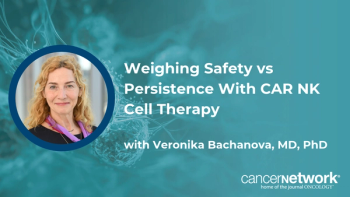
Veronika Bachanova, MD, PhD, discussed how the favorable safety profile of CAR natural killer cell therapies may come with trade-offs in persistence and response durability.
Experts discuss data from the MonumenTAL-3 trial and the evolving roles of talquetamab and other bispecific antibodies in relapsed/refractory multiple myeloma.

Dan Costin, MD, discusses where personalized mRNA vaccines could fit into lung cancer care within 5 to 10 years.
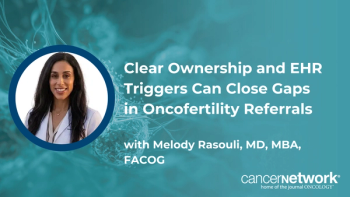
Melody Rasouli, MD, MBA, FACOG, discussed the system breakdowns that delay fertility referrals and how EHR triggers can automate the process.
Advertisement
Advertisement
Trending on CancerNetwork
1
FDA Approves Tucatinib Combo as Maintenance in HER2+ Breast Cancer
2
Selinexor-Based Quadruplet Targets Myeloma After T-Cell Redirecting Therapy
3
Personalized Vaccines May Have Utility Across All Lung Cancer Stages
4
Firmonertinib Misses PFS End Point in First-Line EGFR Exon 20 NSCLC
5