
Opinion|Videos|April 22, 2024
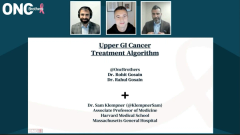
Treating Residual Disease in Upper GI Cancers Following FLOT Treatment
The Oncology Brothers and Sam Klempner, MD, offer comprehensive insights on treating residual disease in upper GI cancers following FLOT treatment.
Advertisement
Advertisement
Related to this article

Sunnie Kim, MD, discussed perioperative durvalumab plus FLOT, ctDNA-guided de-escalation, irAE monitoring, and biomarkers in gastroesophageal cancer.

Rutika Mehta, MD, MPH, discussed biomarker testing, PD-L1–low treatment, FLOT dosing, early referral, and ctDNA in gastroesophageal cancer.
Sunnie Kim, MD, outlined how she monitors for endocrine, renal, pulmonary, and other immune-related adverse events during adjuvant durvalumab.

Rutika Mehta, MD, MPH, shares her framework for growth factor support, global dose reductions, and dropping agents during FLOT therapy.
Sunnie Kim, MD, explains how she uses baseline and postsurgical ctDNA to guide de-escalation conversations for patients struggling after surgery.
Rutika Mehta, MD, MPH, discusses perioperative durvalumab plus FLOT and first-line options for patients with low or negative PD-L1 gastroesophageal cancer.
Sunnie Kim, MD, discusses postoperative management for patients without a pathologic response after neoadjuvant durvalumab plus FLOT.
Rutika Mehta, MD, MPH, explains how she sequences MSI, HER2, claudin 18.2, and PD-L1 testing when tissue is limited in gastroesophageal cancer.
Advertisement
Advertisement
Trending on CancerNetwork
1
Setting Up an HDR Brachytherapy Program Amid a National Decline
2
Zamto-Cel Improves EFS vs R-GemOx in Transplant-Ineligible R/R LBCL
3
Biomarker Sequencing, PD-L1 Status, and FLOT Dosing in Gastroesophageal Cancer
4
CD38-Targeted Immuno-PET Helps Detect Active Multiple Myeloma
5