
Opinion|Videos|April 22, 2024
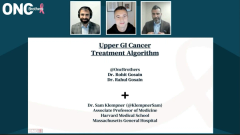
The Role for Comprehensive NGS Testing in Upper GI Cancers
Medical oncologists discuss the role for comprehensive next-generation sequencing (NGS) in upper GI cancers and the potential role for zolbetuximab.
Advertisement
Advertisement
Related to this article

Rutika Mehta, MD, MPH, explains how she sequences MSI, HER2, claudin 18.2, and PD-L1 testing when tissue is limited in gastroesophageal cancer.
A bispecific in biliary tract cancer, dostarlimab organ preservation in rectal cancer, and KRAS G12D data in pancreatic cancer stood out at ESMO 2026.

Futibatinib, pemigatinib, and lirafugratinib showed similar response rates and progression-free survival at first FGFR inhibitor exposure in biliary tract cancers with FGFR alterations.

A post hoc ReFocus analysis found prior immune checkpoint inhibitor exposure raised the risk of mucocutaneous AEs with lirafugratinib.
More than two-thirds of patients with mismatch repair–deficient locally advanced rectal cancer achieved a clinical complete response with dostarlimab alone.
Data from the phase 3 HARMONi-GI1 trial support first-line ivonescimab plus chemotherapy as a new standard of care in advanced biliary tract cancer.
Sone-Ve significantly improved OS vs investigator’s choice in previously treated CLDN18.2-positive gastroesophageal carcinoma in CLARITY-Gastric01.
Advertisement
Advertisement
Trending on CancerNetwork
1
Blood mRNA Model Predicts Castration Resistance in Metastatic Prostate Cancer
2
CD19 CAR T Cell Therapy for Treatment-Refractory Seropositive Rheumatoid Arthritis: A Phase 1 Trial
3
Recapping GI Cancer at ESMO 2026: Standout Data From Phase 1 to Phase 3
4
Outpatient Treatment-Related Toxicity After Hospital Discharge Among Patients Receiving Lifileucel for Advanced Melanoma
5