
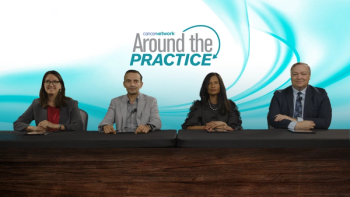
Panelists discuss how patient preferences for treatment-free intervals are increasingly important in therapy selection, with bispecifics offering potential for response-adapted dosing and early discontinuation while maintaining remissions.
Panelists discuss how patient preferences for treatment-free intervals are increasingly important in therapy selection, with bispecifics offering potential for response-adapted dosing and early discontinuation while maintaining remissions.
Panelists discuss how bispecifics are reversing the historical paradigm of diminishing returns in relapsed/refractory multiple myeloma, achieving 60% to 70% response rates lasting over a year in heavily pretreated patients.
Panelists discuss how CAR T-cell therapy should generally precede bispecifics when possible due to T-cell exhaustion concerns, though they agree there are virtually no absolute contraindications to bispecific therapy.
Panelists discuss how real-world data consistently show bispecific efficacy matching clinical trial results despite treating higher-risk patients, and how prophylactic interventions have reduced cytokine release syndrome severity.
Panelists discuss how talquetamab’s unique skin and taste toxicities are manageable through dose modifications and supportive care, with IVIG prophylaxis being crucial for BCMA-targeted but not necessarily GPRC5D-targeted therapies.
Panelists discuss how step-up dosing has successfully transitioned from inpatient-only to hybrid and outpatient models using prophylactic tocilizumab and standardized protocols for managing cytokine release syndrome.
Panelists discuss how community practices need clear protocols for after-hours fever management, adequate caregiver support assessment, and standardized algorithms for cytokine release syndrome treatment across multiple bispecific products.
Panelists discuss how a triple class–exposed patient with comorbidities like COPD represents an ideal candidate for BCMA-directed bispecific therapy over CAR T-cell therapy due to the ability to titrate dosing and manage respiratory infection risks.
Panelists discuss how patients relapsing shortly after BCMA CAR T-cell therapy should receive GPRC5D-targeted bispecifics rather than repeat BCMA therapies, given the evidence that prior BCMA exposure reduces efficacy of subsequent BCMA-directed treatments.
Experts at the 2025 IMS Annual Meeting discussed bispecific antibodies as treatment for multiple myeloma, highlighting various treatment strategies and real-world data insights.