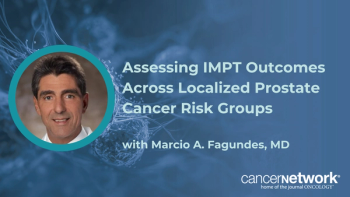
Marcio A. Fagundes, MD, discussed disease control by risk group among 404 patients with prostate cancer treated with intensity-modulated proton therapy.
Bruce Haffty, MD, and Mutlay Sayan, MD, on building radiation oncology at Rutgers, the future of the field, and a remarkable journey from eastern Turkey to Harvard faculty.
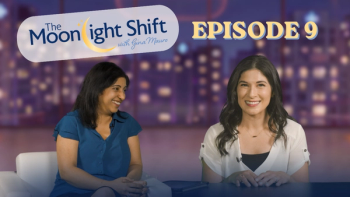
In this episode of The Moonlight Shift, Gina Mauro sits down with Bruce Haffty, MD, the physician who built New Jersey's first academic radiation oncology program from scratch at Rutgers Cancer Institute, and Mutlay Sayan, MD, radiation oncologist at Mass General Brigham Cancer Institute and Harvard Medical School, for their first on-camera conversation together and meeting in five years. What begins as a reunion quickly becomes something rarer: an honest account of what it actually costs to build something in oncology, and what it takes to travel from a village in eastern Turkey to a faculty position at Harvard.
Sayan grew up in a small village near Mount Ararat in eastern Turkey — no electricity, no running water, and no birth certificate. When his father was diagnosed with lung cancer, the entire family relocated to Istanbul, where every member, including a young Mutlay, went to work in a textile factory. Nobody in the family could read or write. To help navigate his father's treatment — to catch the right bus to the right hospital — he needed to learn. He began showing up at the door of a nearby elementary school every lunch break. For three months, he returned each day until the headmaster finally let him in. He was placed in the sixth grade, with the school librarian teaching him to read and write after hours. He graduated as valedictorian of his high school, earned a scholarship to the University of Vermont, and eventually completed his medical training at Rutgers Cancer Institute under Haffty. When he later returned to Boston Logan Airport as a new faculty member at Harvard Medical School, he stood in the terminal and wept. "I did not know any English when I first came," he says. "And now I was faculty at Harvard."
Haffty arrived at what is now Rutgers Cancer Institute in 2005, recruited from Yale by the opportunity to build rather than inherit. At the time, radiation oncology at the institution consisted of two or three community physicians and a single infusion chair. He recruited a chief of physics, a chief of radiation cancer biology, and three faculty members from Hopkins, Yale, and Harvard. All of them are still there. "I knew what I needed," he says. "I just had to recreate what I had at Yale, as long as the institution was committed to giving us the resources." Under his leadership, the program grew into New Jersey's only NCI-designated comprehensive cancer center radiation oncology program. He went on to lead ASTRO, chair the American Board of Radiology, and serves as past president of RSNA.
The episode's clinical conversation centers on a field at a genuine inflection point. Haffty argues that radiation technology has reached near-peak development — the margins are tighter, the dose delivery more precise, the fractionation schedules dramatically shorter — and that the next frontier lies in biology rather than equipment. "I see the future as being able to use radiation in combination with molecular agents, targeted agents, chemotherapy — combining radiation with other agents to really take advantage of the biology of the tumor."
Sayan, whose research includes the Prostate IQ trial using AI models to stratify patient benefit from treatment intensification, describes the rapid evolution from 44-fraction prostate regimens to 5-fraction ultra-hypofractionated protocols — and the clinical trials now determining which patients benefit from which approach.
The episode's game segment walks through five prostate cancer scenarios, with Haffty anchoring the historical approach and Sayan describing current practice. The final scenario — a man in rural eastern Turkey, newly diagnosed with prostate cancer, unable to miss the harvest season for eight weeks of radiation — lands differently after an hour of Sayan's own story. His answer is specific, honest, and one of the most quietly powerful moments the show has produced.
The Moonlight Shift is available on