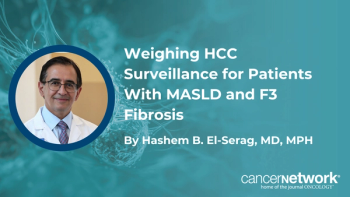
At The Liver Meeting 2026, Hashem B. El-Serag, MD, MPH, discussed when patients with MASLD and F3 fibrosis may merit HCC surveillance.
At The Liver Meeting 2026, Daniel Q. Huang, MBBS, PhD, explained why cirrhosis-based HCC surveillance misses many patients with MASLD and how to find them.
In an interview with CancerNetwork® at The Liver Meeting® 2026, Daniel Q. Huang, MBBS, PhD, senior consultant at the National University Centre for Digestive Diseases and chair of the Hepatobiliary Cancer Programme at the National University Cancer Institute, Singapore, discussed why hepatocellular carcinoma (HCC) related to metabolic dysfunction–associated steatotic liver disease (MASLD) is often diagnosed at a later stage than viral HCC.
Huang pointed to findings from a meta-analysis his group published in 2022, which included 61 studies and 94,636 patients with HCC. In that analysis, 38.5% (95% CI, 27.9%-50.2%) of patients with HCC related to nonalcoholic fatty liver disease (NAFLD), the former name for MASLD, did not have cirrhosis, compared with 14.6% (95% CI, 8.7%-23.4%) of those with HCC from other causes, and only 32.8% (95% CI, 12.0%-63.7%) underwent surveillance before diagnosis, compared with 55.7% (95% CI, 24.0%-83.3%).1
Because current American Association for the Study of Liver Diseases (AASLD) guidance does not recommend routine surveillance for patients with MASLD who do not have cirrhosis, Huang noted that a substantial proportion of patients who develop MASLD-related HCC fall outside existing surveillance strategies.2 He also highlighted the tools available now to help select patients for surveillance, including the Fibrosis-4 (FIB-4) index and transient elastography, and the promise of blood-based biomarkers.
Huang: We looked at this a few years ago, and we, as well as many other groups, found that a large proportion of people with MASLD-related HCC do not have cirrhosis. Current estimates are up to a third, and some go as high as almost 40%. This has big implications for how we survey patients. Current [AASLD] practice guidelines recommend cancer surveillance only for those with cirrhosis; therefore, we are missing a third of patients with MASLD-related HCC who do not have cirrhosis.
What is immediately available are the Fibrosis-4 [FIB-4] index and transient elastography with FibroScan. We use them daily in clinical practice. They are not perfect, and there is ongoing work to be done. In the future, blood-based biomarkers hold great promise for how we might risk-stratify these patients.