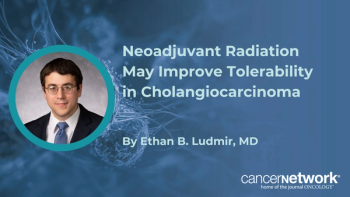
Ethan B. Ludmir, MD, explains the rationale for moving radiation into the neoadjuvant setting for borderline resectable cholangiocarcinoma.
Ethan B. Ludmir, MD, details which cholangiocarcinoma subsets, by tumor location, may benefit most from neoadjuvant radiation before surgery.
Ethan B. Ludmir, MD, an associate professor in the Department of Gastrointestinal Radiation Oncology at The University of Texas MD Anderson Cancer Center, discussed which patients with cholangiocarcinoma may benefit most from neoadjuvant radiation therapy in an interview with CancerNetwork® ahead of the
He identified distal extrahepatic cholangiocarcinoma as the setting where neoadjuvant radiation “shines brightest,” given its anatomic and surgical similarity to pancreatic cancer, while radiation for hilar tumors is more often used as a bridge to liver transplantation. He also highlighted emerging evidence that definitive radiation may improve disease control and survival for patients with unresectable or even metastatic disease, a question now being tested in randomized trials.
CancerNetwork: Which specific patient subsets or tumor locations, intrahepatic vs perihilar or distal, stand to benefit most from neoadjuvant radiation before surgical evaluation?
Ludmir: We can [categorize] them in our minds as intrahepatic vs extrahepatic, writ large. For intrahepatic disease, we don’t have great data in the neoadjuvant or adjuvant settings, and more often, those patients are simply not resectable. For patients who truly are resectable, perioperative chemotherapy and chemoimmunotherapy are paradigms that are evolving and emerging with time. Radiation, for the data that we have, has not played an exceedingly strong role, and those are all very limited data based on [National Cancer Database] analyses and population studies, which are very weak data, as those things go. We don’t tend to believe those data are very high-quality evidence, and we don’t have excellent data to use neoadjuvant or adjuvant radiation for intrahepatic cholangiocarcinoma. That said, at a tertiary or quaternary care center that treats a lot of cholangiocarcinoma, in very select settings for intrahepatic cholangiocarcinoma, we will say, “You know what? We’re very close to this vessel. I want to be able to deliver some radiation so that when we clear that, it’s not against some very large vessel in the liver, and when we do whatever version of a hepatectomy that is required, we’re more likely to get an R0 resection.”
On the flip side, to your question, distal extrahepatic cholangiocarcinoma is probably where neoadjuvant radiation shines brightest. That’s probably because it’s the closest analogy anatomically to pancreatic cancer, and we tend to think the surgical operations are very similar, so that’s where our headspace tends to live. Hilar tumors, which we [ categorize] as extrahepatic disease, are this interesting no man’s land. We often will do radiation, but we don’t do it as a segue to surgical resection. We often do it as a bridge to transplantation, which is something that’s been done by our center, by the Mayo Clinic, and by many others for many years, with different variations of what radiation looks like in that setting.
Far more interesting is the role of radiation outside of the resectable or transplantable setting, where most patients simply do not fit into a surgical or transplant pathway. Most patients are locally advanced, or they have metastatic disease or multifocal intrahepatic [disease], and those pathways look a little more systemic therapy based. The question then is, why would you do locoregional therapy? Wonderful papers from many groups—and we’re privileged to include some studies from our center in those numbers—are suggesting that even in metastatic disease, or even with enormous supermassive tumors that are not surgically resectable and are 20 cm to 25 cm across, doing definitive local therapy with radiation seems to confer meaningful benefits in terms of disease control and survival. We’re now running randomized trials at our center and across the country to answer that question more meaningfully.