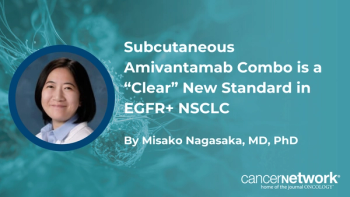
Subcutaneous amivantamab is safer and more convenient for patients compared with the intravenous formulation, according to Misako Nagasaka, MD, PhD.
Xiuning Le, MD, PhD, explains how oncologists should approach HER2 biomarker testing following sevabertinib’s frontline approval in non–small cell lung cancer.
The
Xiuning Le, MD, PhD, an associate professor in the department of Thoracic/Head and Neck Medical Oncology at UT MD Anderson Cancer Center, spoke with CancerNetwork® about how community oncologists should approach HER2 biomarker testing given this distinction.
Transcript:
CancerNetwork: Considering that the label specifies HER2 (ERBB2) TKD-activating mutations tested from tumor tissue or plasma, how should community oncologists think about biomarker testing for this subgroup, given that HER2 alterations in lung cancer can also include amplification that may not all be captured the same way?
Le: Precision oncology starts with the testing, detection, and interpretation of the reports. HER2 is also called ERBB2. There are different types of genetic alterations that can happen in different types of solid tumors. In lung cancer, a mutation in the kinase domain, either as a point mutation or as a short genomic insertion, is oncogenic and can lead to lung cancer development. Accordingly, a precision oncology approach, for example, a HER2-targeting tyrosine kinase inhibitor [TKI] like sevabertinib, can reverse the oncogenesis so the patient derives benefit. That’s why the FDA is very specific in making sure that [patients with] HER2 mutation-positive [disease] would derive benefit from sevabertinib, so that recommendation is very needed.
Related to the topic of activating mutations, HER2 can also be amplified in lung cancer. However, this is not an indication for sevabertinib, as amplification of HER2 in lung cancer hasn’t been established to be oncogenic. In our clinical practice, we have to be mindful in distinguishing between a HER2 kinase domain mutation or insertion vs amplification.
FDA grants accelerated approval to sevabertinib for locally advanced or metastatic non-squamous non-small cell lung cancer. News release. FDA. September 9, 2026. Accessed September 21, 2026. https://tinyurl.com/mwsay6jf