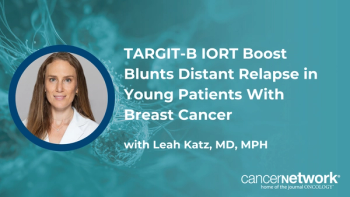
Leah Katz, MD, MPH, explained how an intraoperative tumor bed boost in TARGIT-B may reduce distant relapse in young patients with breast cancer.
Leah Katz, MD, MPH, discussesed NeoORB data on neoadjuvant radiotherapy and why radiation timing may open new treatment paradigms in breast cancer.
In an interview with CancerNetwork® at the
In an interim analysis of 60 patients, neoadjuvant radiotherapy was associated with higher breast pathologic complete response (pCR) rates (51.9% vs 27.3%; P = .046) and nodal pCR rates (88.5% vs 39.4%; P <.001), as well as smaller mean posttreatment tumor volume (2.31 cc vs 22.48 cc; P = .014). Grade 3 or higher surgical complications occurred in 14.8% vs 6.1% of patients, respectively.
Katz said these findings suggest the field may be thinking too narrowly about the conventional surgery-then-radiation framework.
Katz: It’s the same story, in that neoadjuvant radiation offered a greater tumor volume reduction than systemic therapy alone. It was a little bit of a similar story to TARGIT-B, in that it also reduced nodal recurrence. It raises the question: Is something happening at the interface of radiation and an intact tumor that allows for lower recurrence down the line? That’s quite interesting.
As I say in my summary slides, we may be thinking too narrowly about the conventional breast surgery and radiation framework, which is surgery with negative margins, then radiation to kill microscopic disease. Radiation may offer all sorts of treatment paradigms and opportunities if we deliver it at a different time, at a different moment during the breast tumor, meaning in the breast vs out of the breast.
Nair RP, Pareek P, Devnani B, et al. Neoadjuvant radiotherapy in breast cancer: a study on the optimal sequencing of radiation in breast cancer (NeoORB). Presented at: 2026 ASTRO Annual Meeting; September 26-30, 2026; Boston, MA. Abstract LBA 09.