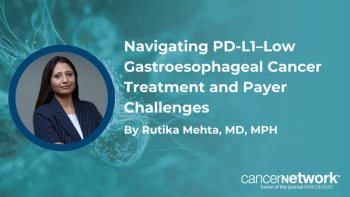
Rutika Mehta, MD, MPH, discusses perioperative durvalumab plus FLOT and first-line options for patients with low or negative PD-L1 gastroesophageal cancer.
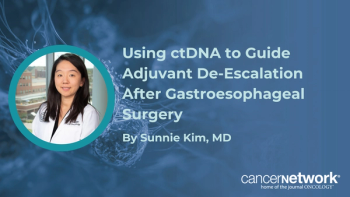
Sunnie Kim, MD, explains how she uses baseline and postsurgical ctDNA to guide de-escalation conversations for patients struggling after surgery.
In an interview with CancerNetwork®, Sunnie Kim, MD, associate professor of medicine in the Division of Medical Oncology at the University of Colorado School of Medicine, and a gastrointestinal medical oncologist at the University of Colorado Cancer Center, discussed how she incorporates circulating tumor DNA (ctDNA) testing into decisions about de-escalating postoperative therapy for patients with gastroesophageal cancer.
Kim explained that she does not use ctDNA-guided de-escalation broadly, but she considers it for patients who are struggling to tolerate adjuvant therapy, such as durvalumab (Imfinzi) plus FLOT (fluorouracil, leucovorin, oxaliplatin, and docetaxel), after a gastrectomy or esophagectomy. For these patients, she obtains a baseline pretreatment ctDNA test and, if postsurgical ctDNA is negative, begins a conversation about stopping therapy. She stressed that this is not yet a fully validated strategy and that she prefers several serial negative ctDNA results before patients completely stop treatment.
Kim: The de-escalation space for me is still very patient dependent, meaning that I don’t use this broadly. As we know, most patients who have undergone a gastrectomy or esophagectomy are struggling. Their anatomy has been completely altered, and it is hard for them to tolerate a treatment like FLOT or FLOT plus durvalumab on the back end. For the patient who is clearly struggling, where you’re not sure you’re going to be able to get them all the recommended doses, I will usually try to get at least a baseline pretreatment ctDNA.
Then, if the postsurgical ctDNA is negative, I’ll have a conversation with the patients who are struggling with further chemotherapy, or if I feel like it might even be unsafe for them to continue. If it’s negative, I’ll say, well, it’s not a fully validated strategy to completely stop, but we can start having conversations, and I’d like to get at least a few serial ctDNA tests before we let them completely stop everything. It is an emerging space right now, but it is still important to take care of the patients who are struggling quite a bit with postoperative therapy.