
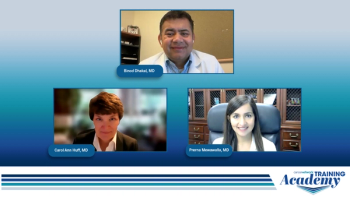
Experts unpack earlier use of BCMA bispecific antibodies in relapsed myeloma, guiding second-line choices, sequencing, and real-world safety management.
Experts unpack earlier use of BCMA bispecific antibodies in relapsed myeloma, guiding second-line choices, sequencing, and real-world safety management.
Learn how clinicians define daratumumab refractoriness vs exposure and why the 60-day rule guides smarter second-line myeloma choices.
Dr. Binod Dhakal and Dr. Carol Ann Huff discuss how anti-CD38 exposure versus true anti-CD38 refractoriness influences treatment selection in relapsed/refractory multiple myeloma (RRMM).
Dr. Binod Dhakal leads a discussion on the increasingly complex treatment landscape of relapsed/refractory multiple myeloma (RRMM), focusing on how clinicians navigate sequencing decisions among BCMA-directed therapies, including CAR T-cell therapy and bispecific antibodies.
Dr. Binod Dhakal leads a discussion on patient selection for BCMA-directed bispecific antibodies in relapsed/refractory multiple myeloma (RRMM), focusing on how these therapies fit within an increasingly complex treatment landscape.
Transitioning into a discussion of emerging clinical evidence, Dr. Binod Dhakal and Dr. Prerna Mewawalla examine the efficacy endpoints that are most meaningful when evaluating BCMA-directed bispecific antibodies in relapsed/refractory multiple myeloma (RRMM).
Dr. Binod Dhakal, Dr. Carol Ann Huff, and Dr. Prerna Mewawalla discuss how differences in patient populations across the MajesTEC clinical program may influence treatment decisions in relapsed/refractory multiple myeloma (RRMM).
Dr. Binod Dhakal, Dr. Prerna Mewawalla, and Dr. Carol Ann Huff discuss practical strategies for managing the safety profile of BCMA-directed bispecific antibodies in relapsed/refractory multiple myeloma (RRMM).
Dr. Binod Dhakal and Dr. Prerna Mewawalla discuss how evolving dosing strategies are helping improve the real-world use of BCMA-directed bispecific antibodies in relapsed/refractory multiple myeloma (RRMM).
Dr. Binod Dhakal, Dr. Carol Ann Huff, and Dr. Prerna Mewawalla discuss the growing number of BCMA-directed bispecific antibody options available for patients with relapsed/refractory multiple myeloma (RRMM) and the practical considerations that influence treatment selection.
Using a case-based scenario, Dr. Binod Dhakal and Dr. Carol Ann Huff explore treatment decision-making for a fit patient with relapsed/refractory multiple myeloma (RRMM) experiencing first relapse approximately 30 months after autologous stem cell transplantation.
Building on the first patient case, Dr. Binod Dhakal and Dr. Prerna Mewawalla discuss how recently presented MajesTEC-9 data may influence treatment selection for patients with relapsed/refractory multiple myeloma (RRMM) who experience an early relapse following frontline therapy.
In the second case-based discussion, Dr. Binod Dhakal and Dr. Prerna Mewawalla examine treatment considerations for an older patient with relapsed/refractory multiple myeloma (RRMM), multiple comorbidities, prior anti-CD38 exposure, and limited suitability for CAR T-cell therapy.
In the concluding scientific discussion, Dr. Binod Dhakal, Dr. Carol Ann Huff, and Dr. Prerna Mewawalla reflect on how emerging clinical evidence is shaping the future role of BCMA-directed therapies in relapsed/refractory multiple myeloma (RRMM).
Experts gathered to discuss various facets of early-relapse multiple myeloma treatment, such as exposure vs refractoriness and CAR T vs bispecifics.