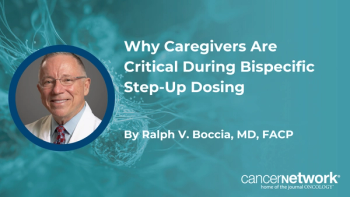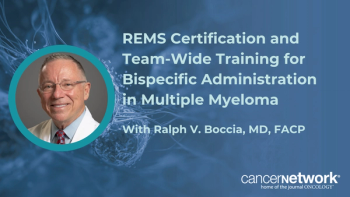
Ralph V. Boccia, MD, FACP, explained who needs REMS certification and which care team members need training to deliver bispecific antibodies.
Ralph V. Boccia, MD, FACP, noted how designated hospitals and a 24/7 on-call team support emergencies during bispecific step-up dosing.
Ralph V. Boccia, MD, FACP, founder of The Center for Cancer and Blood Disorders, clinical associate professor at MedStar Georgetown University Hospital, and medical director of the International Oncology Network Clinical Research Program, described how his practice prepares for emergencies during outpatient step-up dosing of bispecific antibodies, particularly when regional hospitals may face challenges with basic supportive care. Rather than telling patients to go to any hospital, Boccia’s team identifies specific hospitals in advance, educates their staff, and asks patients to stay within 30 to 60 minutes of that facility. Because cytokine release syndrome (CRS) always begins with a fever, patients and caregivers are taught that any fever must be reported immediately, as it signals either CRS or infection. To support this, his clinic maintains a dedicated T-cell team of 2 physicians and 2 advanced practice providers (APPs) who rotate coverage, and patients and caregivers have direct cell phone numbers for each team member rather than relying on an answering service.
Boccia: The first thing we have to do is make sure we know which hospitals we expect the patients to go to. We don’t just randomly say, “If you have a fever, go to the hospital.” We make sure we have educated certain hospital staffs, so they know what to expect when the patient gets there. The patient then needs to be positioned geographically within 30 to 60 minutes of that hospital and has to understand that’s the hospital they go to.
Most of the time, we have a warning that the patient is going to get sick. The beauty of knowing and understanding this is that if the patient is going to get cytokine release syndrome, it always begins with a fever. The patient either has CRS or has an infection, and they’ve got to be seen. The patient and the caregiver understand that, and the connectivity has to occur right at that time. If a patient has a temperature at 7 o’clock at night, you don’t wait until 9 o’clock the next morning. You report it right away.
There has to be a monitoring system set up with the practice, whether it’s the physicians or the APPs, who are available 24/7. In our clinic, we have a specific team of 4 health care providers, 2 doctors and 2 APPs, who are available pretty much all the time. We rotate the responsibility, but the patients and caregivers have 4 cell phone numbers, and they know the first call they make is not to the answering service. It’s directly to the cell phone of a T-cell team member, who will then advise and guide them.