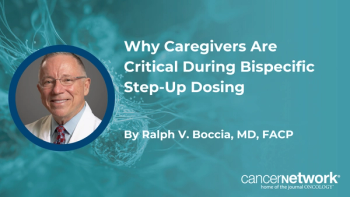
Ralph V. Boccia, MD, FACP, explained the caregiver’s role in monitoring and reporting during bispecific antibody step-up dosing.
Arturo Loaiza-Bonilla, MD, MSEd, FACP, co-founder of Massive Bio and system-wide chief of hematology and oncology at St. Luke’s, explains how AI is matching patients to clinical trials, where the technology falls short, and why he left academia to build what oncology was missing.
When Dr. Arturo Loaiza-Bonilla was seeing patients at the University of Miami, he encountered a problem he couldn’t solve with medicine alone. His clinic served a largely uninsured, underrepresented population — patients who were trial-eligible but effectively invisible to the systems that were supposed to find them. “There was nothing that I could do for those patients,” he said. “But I said, ‘we need to do something.’”
That problem followed him to Penn Medicine, where he discovered that even his colleagues — working in the same department, running the same disease areas — didn’t know what studies were open. Not because they didn’t care, he was quick to clarify, but because the incentives weren’t aligned and the time simply wasn’t there. Therefore, he left academia, co-founded Massive Bio, and started building the infrastructure oncology was missing.
Today, Massive Bio’s AI platform completes end-to-end patient characterization and trial matching in as little as 17 seconds, pulling structured data from any US electronic medical record and cross-referencing it against a fully parameterized clinical trial database developed in collaboration with OpenAI. The platform has helped more than 200,000 patients across 17 countries, earned an NCI SBIR grant, and published a prospective evaluation in 3,800 patients.
In a recent episode of The Moonlight Shift, Loaiza-Bonilla also addressed the limits of the technology he helped build. When asked whether AI can fix inequity in clinical trial access, his answer was measured: alert-based matching systems, he noted — including one randomized at Harvard — showed more matches but zero improvement in enrollment. The gap isn’t identification. It’s engagement, education, and the last mile.
On whether AI will make cancer care more equitable: “Jury still out,” he said. “We can do both.”
The Moonlight Shift is available on