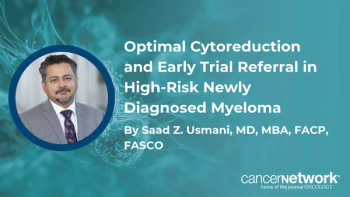
Saad Z. Usmani, MD, MBA, FACP, FASCO, discussed quadruplet induction, extended maintenance, and when a community clinician should call a myeloma center.
Ralph V. Boccia, MD, FACP, explained who needs REMS certification and which care team members need training to deliver bispecific antibodies.
Ralph V. Boccia, MD, FACP, founder of The Center for Cancer and Blood Disorders, clinical associate professor at MedStar Georgetown University Hospital, and medical director of the International Oncology Network Clinical Research Program, explained who in his practice obtains Risk Evaluation and Mitigation Strategy (REMS) certification for bispecific antibodies and what training the broader multidisciplinary team needs.
Boccia described REMS certification as straightforward, taking about 10 minutes per drug, and noted that prescribing physicians must complete it, while advanced practice providers (APPs) often do so as well for the educational value. Beyond certification, he stressed that virtually everyone who interacts with a patient receiving a bispecific needs some understanding of the therapy. Front desk staff must know when to route calls to a triage nurse, and medical assistants must accurately capture vital signs. Physicians and advanced practice providers (APPs) must select appropriate patients and confirm that a caregiver is in place, while infusion nurses, triage nurses, and pharmacists each play a role in administering treatment, fielding toxicity calls, and educating patients.
Boccia: Getting certified for the REMS programs is a real piece of cake. Basically, all the health care providers who want to prescribe these agents do that, so our physicians need to do it. The APPs don’t always have to, because the patient is already on treatment; they’re not choosing a patient, they’re monitoring a patient. Many of them still get REMS certification. The REMS certification process takes about 10 minutes, and you do it one time per drug, so it’s not that big a deal. There’s a learning experience in doing it, so that’s additional education.
Virtually everyone needs at least an understanding of what treating a patient with a bispecific involves. If you think about it, even the front desk staff, who don’t have any real medical education, need it. If a patient calls in and needs an appointment, they need to understand how that patient may be very different from another patient. If the patient calls in with a problem, the front desk needs to know: Do I send this to a triage nurse? Do I have the patient come in right away to see the health care provider? Even at that level, it’s necessary to know.
Then think about all the people who touch the patient, such as medical assistants. They have to make sure they accurately take a brief history and get a good blood pressure, pulse, and oxygen saturation, so they need some understanding of what they’re doing and why. Then our health care providers, whether that’s an APP or a physician, are the ones who have to understand what’s an appropriate patient and what’s an appropriate management strategy. How do I make sure the patient is safe? Do they have the proper caregiver, someone who’s going to do the reporting during the step-up phase, when the patient may not be able to accurately convey issues and problems? Of course, there are the infusion nurses who administer the drugs, the triage nurses who might be taking calls from patients who have adverse effects and toxicities, and our pharmacists, who are critical because they are also part of the teaching process, like our APPs, to get patients ready to start, to help them understand what to expect, and to monitor them during this phase.