
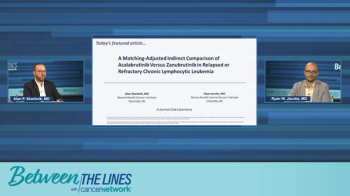
A Matching-Adjusted Indirect Comparison of Acalabrutinib Versus Zanubrutinib in Relapsed or Refractory Chronic Lymphocytic Leukemia
A Matching-Adjusted Indirect Comparison of Acalabrutinib Versus Zanubrutinib in Relapsed or Refractory Chronic Lymphocytic Leukemia

Medical oncologists who specialize in gastrointestinal cancers offer clinical insights on monitoring patients following treatment with adjuvant chemotherapy.

Nausheen Ahmed, MD, and Al-Ola Abdallah, MD, discuss the use of CAR T-cell therapy in patients with transplant-ineligible multiple myeloma.
The expert panel gives an overview of factors that influence treatment decisions in patients with transplant-ineligible multiple myeloma.
Focused discussion on the advent of cytokine release syndrome in MajesTEC-1 and how it compared to the benefits derived from teclistamab therapy.

Experts from Ochsner Health close out their panel on multiple myeloma management by identifying unmet needs and sharing excitement for future evolution in the treatment landscape.
A comprehensive discussion on treatment decision-making for patients with colorectal cancer following the IDEA collaboration analysis.
Shared insight from a panel of experts on the current state of cytogenetics in myelofibrosis and how it impacts treatment pathways for patients.

Expert panelists provide an overview of the signs and symptoms indicative of myelofibrosis and consider factors that help to inform prognostication.

Eunice S. Wang, MD, shares first-line treatment approaches for patients with NPM1-mutant AML, discussing current clinical data.
The panel discuss the need for personalized treatment approaches for young, fit patients with newly diagnosed acute myeloid leukemia, as well as when transplant should be considered.
Clinical pearls for community oncologists concerning the real-world application of existing treatments while considering feasibility, cost, and ease of care.
Conversation centered around patient frailty, Dr. Cook and Dr. Pianko emphasize the importance of accurately assessing frailty and adjusting treatment plans accordingly.
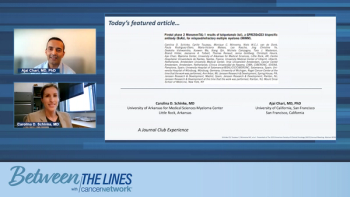
Expert hematologist-oncologists identify long-term data from MonumenTAL-1 regarding infection rates in patients with relapsed/refractory multiple myeloma.
Following their review of data from MonumenTAL-1, Ajai Chari, MD, and Carolina Schinke, MD, share practical considerations for real-world use of talquetamab in relapsed/refractory multiple myeloma.

Brian Rini, MD, reviews data from the 5-year analysis of the KEYNOTE-426 trial in advanced clear cell renal cell carcinoma.
Robert Motzer, MD, presents the overall survival analysis data from the 4-year follow-up of the CLEAR study in patients with advanced renal cell carcinoma.

Drs. Koprivnikar, McCloskey, and Cho delve into the diagnostic process in acute myeloid leukemia (AML), treatment approaches for AML, and factors influencing treatment selection.
A closer look at the current unmet needs in MPN treatment, ongoing trials, and recent updates such as the MOMENTUM and FREEDOM trials.
Shared insight on the standard work-up and staging practices used when a patient presents with newly diagnosed bladder cancer.
Expert panelists review a patient presentation of bladder cancer and consider the typical signs and symptoms that may lead to a diagnosis.
Focused discussion on how patients receiving bispecific therapy for multiple myeloma are transitioned into and managed within the community setting.

Expert panelists share insight on transitioning patients on bispecific therapy from an academic or specialty center to the community setting.

Dr. Daver anticipates how the MDS landscape will evolve over time, emphasizing the importance of adopting targeted therapies.
Subject-matter expert provides an overview of the CD47 pathway and shares how emergent trial data are impacting the MDS treatment landscape.

Catherine Wei, MD, and David Witt, MD, explain some of the reasons they would recommend treatment with bispecific antibodies to their patients with multiple myeloma.
Shared insight on uncommon EGFR mutations in patients with non–small cell lung cancer and how they fit into the larger disease paradigm.

Syed S. Ali, MD, and Noffar Bar, MD, share their practical experience with bispecific antibodies in the treatment of patients with multiple myeloma.
Trastuzumab deruxtecan appears to elicit ‘impressive’ responses among patients with HER2-positive gynecologic cancers regardless of immunohistochemistry in the phase 2 DESTINY-PanTumor02 trial.