
A discussion on when to switch a patient with myelofibrosis to a new JAK inhibitor treatment, and possible strategies for transitioning.
A discussion on when to switch a patient with myelofibrosis to a new JAK inhibitor treatment, and possible strategies for transitioning.
Kim A. Reiss Binder, MD, spoke about the use of niraparib plus either nivolumab or ipilimumab for patients with platinum-sensitive advanced pancreatic adenocarcinoma.
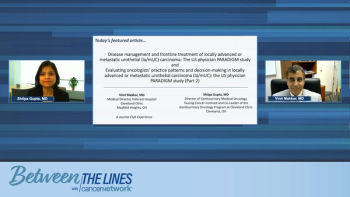
Drs Gupta and Makkar conclude their discussion by highlighting key takeaways from the PARADIGM study and future directions that may address unmet needs in the field of la/mUC.
A look at the key factors associated with 1L and 1LM therapy prescription frequency in the PARADIGM study.
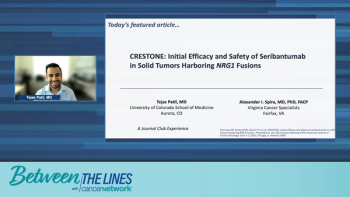
Looking toward the future management of solid tumors with NRG1 fusions, expert panelists consider how the availability of seribantumab therapy may impact their practice.
Key opinion leaders in the management of breast cancer discuss the role of the radiation oncologist in treating patients with brain metastases.

Centralizing the conversation on trastuzumab deruxtecan, panelists comment on treatment toxicity and factors to consider when sequencing therapies in later lines of treatment.
Closing out their discussion on relapsed/refractory multiple myeloma, experts consider adverse event management in patients receiving bispecifics followed by future directions in care.
Roy Herbst, MD, PhD, provides insight on the importance of EGFR mutations, both common and rare, in patients with non–small cell lung cancer.
Expert perspectives on molecular profiling strategies that may help overcome barriers to testing in non–small cell lung cancer.
Valentina Boni, MD, PhD, spoke about the rationale behind using lurbinectedin monotherapy for pretreated BRCA1/2-associated metastatic breast cancer.
Saad Z. Usmani, MD, MBA, FACP, spoke about the safety profile of standard triplet therapy with or without elotuzumab for patients with newly diagnosed, high-risk multiple myeloma in the phase 3 SWOG 1211 trial and how results of this trial may be used in future datasets to inform treatment in this setting.
C. Ola Landgren, MD, PhD, discusses progression-free survival data from the phase 3 DETERMINATION trial examining lenalidomide, bortezomib, and dexamethasone with or without autologous stem cell transplant plus continuous lenalidomide maintenance in patients with newly diagnosed multiple myeloma.
Mark Pegram, MD, discussed the highlights from ASCO 2022, regarding antibody drug conjugates.
John Mascarenhas, MD, presents a clinical scenario of a 73-year-old man with myelofibrosis and a low platelet count.
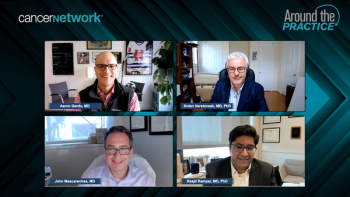
A panel of experts considers treatment options for patients with myelofibrosis based on platelet counts, while factoring in health insurance barriers.
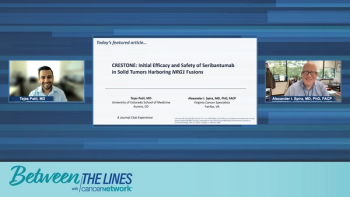
A brief review of key takeaways from the CRESTONE clinical trial of seribantumab therapy in solid tumors with NRG1 fusions.
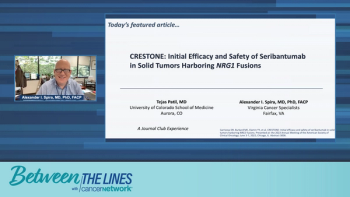
Closing out their review of data from the CRESTONE clinical trial, expert panelists highlight the duration and depth of response with seribantumab therapy.
Drs Gupta and Makkar discuss results from the PARADIGM cross-sectional survey, which reveals physicians’ 1L and 1LM treatment patterns in la/mUC.
Experts discuss results from the targeted literature search and qualitative interviews, which identify important factors that impact their treatment decisions for patients with locally advanced/metastatic urothelial carcinoma.
Howard A. Burris, MD, highlighted previous findings of the phase 3 TOPAZ-1 trial assessing durvalumab plus gemcitabine and cisplatin vs placebo plus gemcitabine and cisplatin in advanced biliary tract cancer and patient-reported outcomes data that were presented at 2022 ASCO.
To discuss treatment options beyond the frontline setting, Erika Hamilton, MD, presents the clinical scenario of a 43-year-old woman with HER2+ mBC who progressed on paclitaxel/trastuzumab/pertuzumab.
Ryan Jones, MD, reflects on factors to consider when selecting stereotactic radiosurgery vs whole-brain radiotherapy including performance status, extracranial control, number of lesions, and CNS progression.
Expert oncologist Roy Herbst, MD, PhD, provides a comprehensive overview of actionable mutations and molecular profiling in NSCLC.
Before closing out his discussion on NSCLC, Sandip Patel, MD, shares his excitement for evolving targeted strategies and improved patient outcomes.
At 2022 ASCO, Paul G. Richardson, MD, dives into results of the DETERMINATION study, which examined triplet therapy with lenalidomide plus either lenalidomide maintenance until progression or autologous stem transplantation in newly diagnosed multiple myeloma.
Comprehensive perspectives on the role of bispecific antibodies in the treatment of relapsed/refractory multiple myeloma.
A brief review of the use of CAR T-cell therapy in patients with relapsed/refractory multiple myeloma.
Biagio Ricciuti, MD, spoke about results of pembrolizumab monotherapy administration in patients with non–small cell lung cancer who had a PD-L1 tumor proportion score of 90% or more.
Saad Z. Usmani, MD, MBA, FACP, discusses the use of lenalidomide, bortezomib, and dexamethasone with or without elotuzumab for newly diagnosed, high-risk multiple myeloma.