Discover the latest FDA-approved therapy for high-risk smoldering myeloma, enhancing early intervention strategies and patient care discussions.
Discover the latest FDA-approved therapy for high-risk smoldering myeloma, enhancing early intervention strategies and patient care discussions.
Explore the evolving landscape of smoldering myeloma treatment, focusing on fixed-duration therapy and patient-provider communication strategies.
Explore the latest findings on smoldering myeloma treatments, including lenalidomide's effectiveness and the importance of patient monitoring in clinical trials.
Daratumumab shows promise in managing smoldering myeloma, balancing infection risks and adverse effects while offering a preferable alternative to lenalidomide.
Experts discuss the impact of daratumumab on smoldering myeloma, exploring survival rates, treatment options, and the importance of clinical trials.
Explore the AKELA trial's findings on patient characteristics and the impact of daratumumab on progression-free survival in myeloma treatment.
The AQUILA trial explores a fixed-duration therapy for myeloma, aiming to balance effective treatment with reduced long-term toxicity for patients.
Early intervention in myeloma treatment addresses critical patient needs, highlighting new trial data and the importance of tailored therapies for better outcomes.
Explore the evolving landscape of high-risk smoldering myeloma treatment options and the challenges in patient management and risk assessment.
Explore the evolving treatment strategies for high-risk smoldering multiple myeloma, emphasizing early intervention and recent clinical advancements.
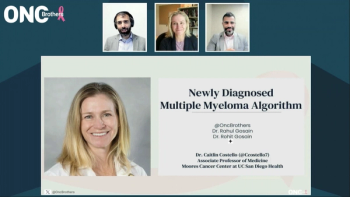
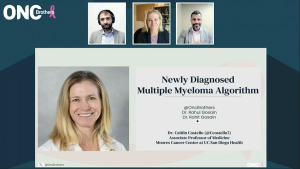
Caitlin Costello, MD, offers concluding remarks and guidance to healthcare providers on optimizing multiple myeloma patient care.
A medical expert shares her treatment approach for a high-risk multiple myeloma patient, considering transplant eligibility, dose escalations, and maintenance therapy based on induction regimen and patient risk factors.
Caitlin Costello, MD, shares insights on the role of minimal residual disease (MRD) assessment in the multiple myeloma treatment process, including its impact on induction therapy and disease monitoring.
A medical expert discusses tailoring treatment strategies for standard-risk and high-risk multiple myeloma patients, considering patient characteristics and transplant eligibility when selecting treatment combinations.
Caitlin Costello, MD, explores the evolving role of biomarkers in the early diagnosis and treatment of multiple myeloma, highlighting their impact on the changing landscape of the disease.
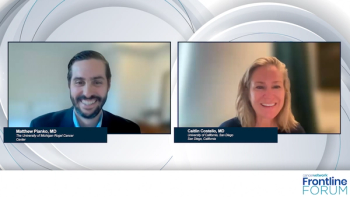
Drs Costello and Pianko close their discussion by sharing advice for clinicians administering bispecifics to their patients with relapsed/refractory multiple myeloma.
Experts discuss key data on the outpatient management of teclistamab.
Matthew Pianko, MD, explains how patients with relapsed/refractory multiple myeloma are monitored for CRS and ICANS.
Caitlin Costello, MD, shares her thoughts on administering teclistamab to patients with relapsed/refractory multiple myeloma in an outpatient setting.
Key opinion leaders discuss how bispecifics are administered at their institutions.
Experts review how the treatment landscape for relapsed/refractory multiple myeloma shifted with the addition of bispecifics, and the currently approved bispecifics available.
An expert briefly reviews the role of GPRC5C-targeting bispecifics in Relapsed/Refractory Multiple Myeloma (R/R MM) following four previous lines of therapy, comparing its efficacy and characteristics with other treatment options like BCMA and CAR-T therapies. She also provides insights into the benefits, risks, and potential challenges related to the access and utilization of GPRC5D-targeting bispecifics, providing a comprehensive overview of considerations in the advanced R/R MM treatment landscape.
Dr. Costello explores the mechanism of action (MOA) of talquetamab and its distinctive role in Relapsed/Refractory Multiple Myeloma (R/R MM), drawing comparisons with other bispecific therapies.
Caitlin Costello, MD, discusses her insights and considerations when choosing the next line of therapy in a patient with relapsed/refractory multiple myeloma.
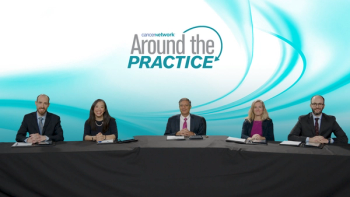
Closing out their discussion on the management of multiple myeloma, expert panelists highlight unmet needs and look toward future directions in care.
Expert perspectives on the advent of CAR T-cell therapy in relapsed/refractory multiple myeloma, and how its role may integrate with bispecific antibody therapy.
Before closing out their discussion on bispecific antibodies in relapsed/refractory multiple myeloma, key opinion leaders consider optimal sequencing of these agents.
A brief review of non–BCMA-targeted bispecific antibodies under investigation in patients with relapsed/refractory multiple myeloma.
Expert perspectives on recent clinical data on BCMA-targeted bispecific antibody therapy in patients with relapsed/refractory multiple myeloma.
Turning to the last module, expert panelists discuss the treatment armamentarium for patients experiencing early relapse in multiple myeloma.

September 22nd 2022
February 13th 2023