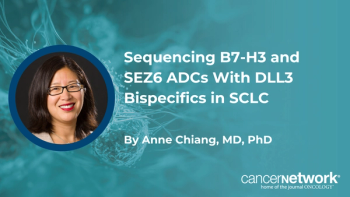
ADCs directed towards B7-H3, SEZ, DLL3, and TROP2 appear to be “super exciting,” according to Anne Chiang, MD, PhD.
Anne Chiang, MD, PhD, discusses how community practices can deliver bispecifics, monitor for CRS, and offer trials for patients with SCLC.
Patients with small cell lung cancer (SCLC) often decline quickly, leaving limited time to access new therapies such as bispecific T-cell engagers. In the
Anne Chiang, MD, PhD, spoke with CancerNetwork® about considerations for trial referral, delivering bispecifics, and monitoring for toxicities in the context of a presentation she gave at the 44th Annual Chemotherapy Foundation Symposium (CFS®), hosted by Physicians’ Education Resource®, LLC, which was titled “Small Cell Updates: Steps Backward, Leaps Forward.” Chiang is an associate professor of Medicine in the Section of Medical Oncology; associate cancer center director of Clinical Initiatives; and vice chief of Clinical Affairs, Medical Oncology and Hematology at Yale School of Medicine.
Transcript:
CancerNetwork: Patients often decline quickly and have limited time to access new therapies. How do you handle trial referral, bispecific delivery, and CRS monitoring in community settings?
Chiang: In Connecticut, we have the benefit of a really integrated network throughout the state. We have 16 different centers, and there are disease-specific thoracic medical oncologists at those sites, so we all meet at a regular weekly meeting. If they have patients they want to send in for tarlatamab and CRS monitoring, I’ll do the first 2 doses and send them back. I’ve also talked to them about setting up those systems locally, and I’ve helped other folks in the community in Connecticut, at outside hospitals, set up their programs.
I think what’s most important is getting patients access to the drugs they need. Whatever can be done locally should be done locally, for the ease of the patient and their support system. But if trials are only available in certain places, then I’m happy to work with the community oncologists to make sure their patients can have access to those new modalities or exciting trials and, at the same time, remain connected locally. This is the approach I’ve talked to [people] across the country about. Most of our patients are treated in the community, so it behooves everybody to serve their patients where they live. That being said, it depends on the ability of your practice to manage [adverse] effects such as CRS, or your access to trials. Usually, there’s some working relationship between the community oncologist and the academic center.
The last thing I’ll say about CRS monitoring is that in the DeLLphi-305 trial, the CRS rates were really low. There was basically one patient in the tarlatamab/durvalumab arm who had grade 3 [CRS], and there were no grade 3 ICANS events. I think that’s partially because you’ve already cytoreduced the tumor, so there’s less of a chance of having CRS. The trial itself was also outpatient, so [it is important] to have very close safety monitoring. Perhaps you can do that in a controlled way as an outpatient, with visits back in to see the oncologist on day 1, day 2, day 8, and day 9, for example.
Sands J, Yoshida T, Ahn MJ, et al. Tarlatamab plus durvalumab vs durvalumab as first-line maintenance therapy following first-line durvalumab, platinum, and etoposide in extensive-stage small cell lung cancer: primary analysis of the phase 3 DeLLphi-305 trial. Presented at: European Society for Medical Oncology (ESMO) Congress 2026; October 23-27, 2026; Madrid, Spain. Abstract LBA3.