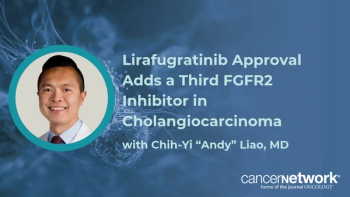
Chih-Yi “Andy” Liao, MD, discusses the FDA approval of lirafugratinib and what the field has learned about resistance to FGFR2 inhibitors.
At EHA, Benoit Tessoulin, MD, PhD, shared data showing the epcoritamab/R² combination benefitted all relapsed/refractory follicular lymphoma subgroups.
At the
According to Benoit Tessoulin, MD, PhD, the primary analysis of the trial established superior disease control with the epcoritamab combination, yielding a progression-free survival (PFS) HR of 0.21. This subsequent subgroup analysis sought to determine whether those efficacy outcomes remained uniform across diverse patient and disease risk profiles.
The analysis confirmed that the clinical benefit held true across all evaluated cohorts, including patients stratified by age, comorbidity burden, tumor size, number of prior lines of therapy, and progression of disease within 2 years of initiating frontline therapy (POD24) status. Across all subgroups, the HRs consistently ranged between 0.2 and 0.3, aligning with the overall study population and reinforcing the combination's broad therapeutic potential.
Tessoulin is a hematologist at Centre Hospitalier Universitaire de Nantes in Nantes, France.
Tessoulin: The main background was that the EPCORE FL-1 trial demonstrated improved disease control in terms of PFS and [objective response rate (ORR)] with the new combination of epcoritamab plus R² compared with R² alone in patients with relapsed or refractory follicular lymphoma, with a magnitude of 0.21 in terms of HR. The whole point of this subgroup analysis was to ask whether that benefit holds true across different kinds of patients, both in terms of patient-level risk factors and disease characteristics.
The question we asked was whether the subgroup analyses held true across all kinds of patients in terms of disease risk and patient risk. When you look at the patient side, including age, comorbidity burden—and from the disease point of view, the number of prior lines of therapy, tumor size, POD24 status, and other factors—the HRs across all of these subgroups sit between 0.2 and 0.3, perfectly aligned with the overall population result. All subgroups derived a benefit from epcoritamab plus R² compared with R² alone.
Nijland M, Falchi L, Linton K, et al. Clinically relevant subgroup analysis from the randomized phase 3 EPCORE FL-1 trial: treatment effect of epcoritamab with lenalidomide and rituximab in R/R follicular lymphoma. Presented at: European Hematology Association Annual Meeting; June 11–14, 2026; Stockholm, Sweden. Abstract S229.