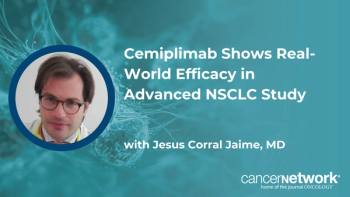
Jesus Corral Jaime, MD, reviews real-world survival and response data for cemiplimab monotherapy from the CEMI-LUNG study.
The risk of infections with epcoritamab plus R2 appeared to level off after the first 4 cycles of therapy in the EPCORE FL-1 trial.
CancerNetwork® spoke with Bradley D. Hunter, MD, about data from the
According to Hunter, medical director of oncology research, director of immune effector cell therapy, and an attending physician of hematologic malignancies and bone marrow transplant at Intermountain Healthcare, infections appeared to be more frequent with combination therapy, although the risk of these toxicities leveled off after the first 4 cycles of therapy.
In the trial, one of the primary end points was progression-free survival. The hazard ratio for epcoritamab plus R2 was 0.21, meaning that there was a 79% reduction in the risk of progression in patients who received epcoritamab with R2 vs R2 alone. Additionally, time to next treatment was significantly prolonged in patients who received epcoritamab plus R2 and were 85% less likely to need the next treatment within the time frame of the trial.
The rates of infections, including grade 3 or higher clinically significant infections, were higher in the epcoritamab plus R2 arm as opposed to R2 alone. While a relatively [small number] of patients discontinued the trial because of those infectious toxicities, 6%, it was only 1% in the R2 arm. That is part of the risk-benefit analysis for patients: we see higher rates of infections. Those infections tend to be at their highest intensity for the first few cycles of therapy, and then that risk tends to kind of level off over about after about cycle 4. But it is a difference between the treatment arm or the experimental arm and the control arm.
Hunter BD, Falchi L, Nijland M, et al. Phase 3 results from the EPCORE FL-1 trial of epcoritamab with lenalidomide and rituximab (R2) versus R2 for relapsed or refractory follicular lymphoma. Presented at: 2026 Society of Hematologic Oncology (SOHO) Annual Meeting; September 9-12, 2026; Houston, TX. Abstract IBCL-1332.