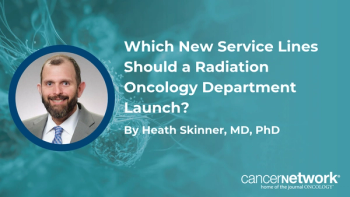
Heath Skinner, MD, PhD, discussed the 3 considerations that determine which new radiation oncology service lines his network chooses to build.
Nikolai Strusberg, MD, discussed how proton therapy reduced clinical hypothyroidism vs photon therapy after supraclavicular breast irradiation.
In an interview with CancerNetwork® at the
Strusberg reported that clinical hypothyroidism occurred in 5.8% of patients in the proton arm vs almost 19% in the photon arm, and that photon therapy was associated with nearly 3-fold higher odds of clinical hypothyroidism after multivariate adjustment. He also explained that thyroid sparing is achievable with modern photon techniques, emphasizing that the thyroid should be treated as an organ at risk and that thyroid dose, rather than modality alone, is the key consideration. In the study, the median mean thyroid dose was 17.2 Gy with protons vs 26.8 Gy with photons. When mean thyroid dose was added to the multivariable model, the association between modality and clinical hypothyroidism was no longer significant (adjusted OR, 1.44; 95% CI, 0.45–4.93; P = .546), while each additional Gy of mean thyroid dose was associated with higher odds (OR, 1.07).
Strusberg: We found a very clinically meaningful difference when comparing modalities. Clinical hypothyroidism was 5.8% in our proton arm compared with almost 19% in our photon arm, so you can see it’s almost a 13-percentage point difference. Even after multivariate adjustment, we saw almost 3 times higher odds in the photon arm compared with the proton arm, with a final adjusted odds ratio of 2.94.1
Strusberg: With modern photon techniques such as IMRT or 3D conformal planning, you can achieve adequate field optimization to spare the thyroid. The main highlight of our study is that we have to consider the thyroid as an organ at risk, and that we should consider its dose rather than comparing modalities. For instance, in our cohort, the proton patients had a mean thyroid dose of 17 Gy compared with 27 Gy in the photon cohort. There is a substantial difference right there in the amount of dose the thyroid is receiving.
Strusberg N, Herrera R, Wang D, et al. Does intensity modulated proton therapy reduce clinical hypothyroidism after supraclavicular irradiation for breast cancer? Presented at: 2026 ASTRO Annual Meeting; September 26–30, 2026; Boston, MA. Poster 2831.