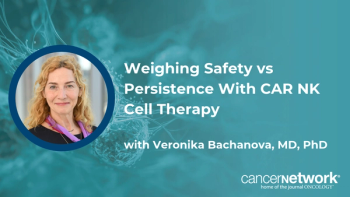
Veronika Bachanova, MD, PhD, discussed how the favorable safety profile of CAR natural killer cell therapies may come with trade-offs in persistence and response durability.
Andrew Evens, DO & Joanna Rhodes, MD, on CLL's transformation, CAR-T vs bispecifics, Hodgkin survivorship, and delivering world-class lymphoma care across NJ.
In this episode of The Moonlight Shift, Gina Mauro sits down with Andrew Evens, DO, MBA, MSc, SVP, who serves as chief medical officer of Oncology Services, RWJBarnabas Health Medical Group and RWJBarnabas Health; deputy director for clinical services and chief physician officer of Rutgers Cancer Institute and the Jack & Sheryl Morris Cancer Center
Cancer Doesn’t Travel Well
The episode’s animating idea comes from a tagline the Rutgers program actually means: cancer doesn’t travel well, and neither should the people fighting it. Evens describes a 17-hospital oncology network spanning nearly 300 oncologists and 150 nurse practitioners across New Jersey—built on the principle that a patient in Toms River shouldn’t have to drive 90 minutes to New Brunswick for every visit. The episode includes a concrete illustration: a patient with mantle cell lymphoma who drove an hour and a half to enroll in a new immunotherapy trial, only to have the trial opened at her local center within 10 days. “Keep cancer care close to home” is not aspirational language at Rutgers—it is the operational standard.
The Transformation of Lymphoma
The clinical substance of the episode is one of the most compelling in the show’s run. Rhodes describes the state of CLL today—between BTK inhibitors, venetoclax (Venclexta)-based fixed-duration combinations, and continuous therapy—as “the epitome of shared decision making,” with treatment selection now driven by patient preference, financial toxicity, and side effect profile rather than efficacy alone. She recalls sitting on a panel with a sarcoma specialist and a pancreatic cancer specialist while describing choosing between medications based on side effect profiles: “Everyone looked at me with jealousy.”
The MBA That Changed Everything
One of the episode’s most distinctive moments comes when Evens describes intentionally sunsetting his translational research lab before the pandemic to pursue an executive MBA at Rutgers. The decision was deliberate: he had become convinced that getting treatments to patients at scale required financial, business, and supply chain literacy that his clinical training hadn’t provided. “You could have the greatest treatments, but if you can’t get it to them wherever they are in their community—it takes all the way to the end.” The MBA was the infrastructure answer to a clinical problem.
CAR-T, Bispecifics, and the Access Question
The conversation on relapsed/refractory large B-cell lymphoma covers the CAR-T versus bispecifics debate with unusual specificity. Rhodes argues that bispecifics will fill a critical access gap for the patients who cannot reach a CAR-T center—noting that Rutgers is weeks away from opening CAR-T at two community sites, including Monmouth Medical Center in Long Branch, New Jersey. Evens expresses hope for off-the-shelf CAR-T options that would allow community administration. Both agree that the question is less “which is better” than “who can actually get there.”
The game segment produces its most charged moment in the opening prompt: “BTK inhibitors should be the default first-line choice for most CLL patients today.” Both Evens and Rhodes immediately said “different chapter”—signaling genuine clinical nuance behind a statement that might appear settled. The episode closes with the final game prompt: “A lymphoma patient in New Jersey gets care equivalent to what they’d receive at a major academic institution elsewhere.” The answer from both, without hesitation: 100% agree.
The Moonlight Shift is available on