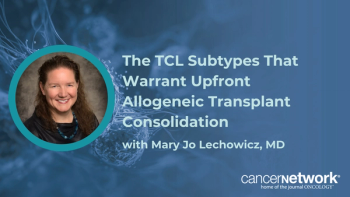
Adult T-cell lymphoma and leukemia may warrant upfront allogeneic transplant, according to Mary Jo Lechowicz, MD.
Mary Jo Lechowicz, MD, discussed how pre-transplant depth of response informs the choice between autologous and allogeneic HSCT in T-cell lymphoma.
In an interview with CancerNetwork® at the
Lechowicz explained that while retrospective data demonstrate that patients with partial responses can derive benefit from autologous HSCT, given that autologous transplant is fundamentally dependent on chemo-responsiveness, depth of remission predicts longer-term progression-free survival in both autologous and allogeneic settings. Rather than a universal threshold mandating a switch to allogeneic HSCT, the decision remains patient specific and is shaped by allogeneic eligibility, toxicity considerations, and the clinical concern that a partial remission raises for primary refractory or early relapse disease. For patients in the latter category, she recommended initiating donor typing early to preserve the option.
Transcript:
Lechowicz: It is always going to be patient specific in terms of what is mandatory and who [can] have an allogeneic transplant. While there are retrospective data showing that patients with a partial response can have some benefit from an autologous transplant, we know that autologous transplant is based on chemo-responsiveness. For both autologous and allogeneic transplant, depth of remission portends toward longer-term progression-free survival.
The other thing to consider is toxicity. There are patients who may not be allogeneic eligible, and we sometimes consider an autologous transplant. However, if a patient has a partial remission, we become concerned about primary refractory disease or early relapse; those are the patients we would type and evaluate for an allogeneic transplant option.
Lechowicz MJ. Auto versus allo transplant for T-cell lymphomas. Presented at: 2026 Society of Hematologic Oncology (SOHO) Annual Meeting; September 9-12