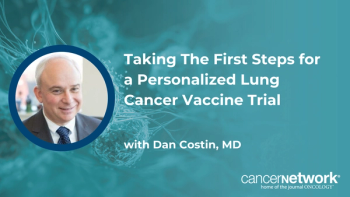
Dan Costin, MD, describes counseling his first patient on a personalized mRNA vaccine vs observation in the INTerpath-014 trial.
Dan Costin, MD, discusses where personalized mRNA vaccines could fit into lung cancer care within 5 to 10 years.
The investigational personalized mRNA vaccine intismeran autogene (V940) is being tested with or without pembrolizumab (Keytruda) in the phase 3 INTerpath-014 trial (NCT07513376) for patients with completely resected, high-risk stage I non–small cell lung cancer (NSCLC).1 The approach builds on positive data from the phase 3
Dan Costin, MD, director of the White Plains Hospital Center for Cancer Care, spoke with CancerNetwork® about where he sees personalized cancer vaccines fitting into lung cancer care, and oncology more broadly, over the next 5 to 10 years if ongoing studies continue to succeed.
Transcript:
CancerNetwork: Looking beyond this specific trial, where do you see personalized cancer vaccines fitting into lung cancer care in 5 years? Do you see it as a niche option for high-risk early-stage disease, or as a more standard part of the adjuvant toolkit?
Costin: In 5 years, I think [personalized vaccines] are going to be used across all stages of lung cancer treatment. What’s astonishing is how tolerable these vaccines are. So far, we’re not seeing any significant increase in [adverse] effects beyond arm pain, a little swelling, and maybe some fevers or chills, the types of [adverse] effects we’d expect from any newer vaccine, whether it’s an mRNA vaccine for COVID-19 or a tetanus or pneumococcal vaccine. In a sense, that tells us it’s working.
I would foresee this becoming routine not just for lung cancer, but for kidney cancer, bladder cancer, and head and neck cancers because to treat cancer, we start with pathology; we never treat based on an X-ray alone. We don’t treat based on a sheet of paper; we need tissue. Whether we remove the tumor, which would be ideal in early-stage disease, or get a biopsy in someone with advanced disease, we’re going to have tissue, and we’re going to be able to make a vaccine. I could foresee a situation where, once you’re diagnosed with cancer, the tissue goes to the pathologist so they can tell us about the cancer, but at the same time, the tissue is also going to the lab so they can start making a vaccine.
Costin: Looking 10 years out, if these vaccines work as well as we hope, maybe we start to de-escalate therapy. Right now, we’re adding to treatment: surgery, a little chemotherapy, a little immunotherapy, and now the vaccine. But maybe the vaccine becomes the heavy lifter, and we can pull back on some of the chemotherapy. That would be exciting, because it would also reduce [adverse] effects. This isn’t just for lung [cancer] either; we know it’s working for melanoma, and hopefully we’ll see the same for lung. I think we’re going to see it across the board.