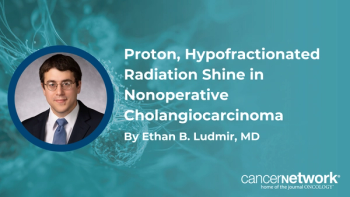
Ethan B. Ludmir, MD, explains why advanced radiation techniques like protons fit nonoperative cholangiocarcinoma better than the preoperative setting.
William A. Hall, MD, discussed how preoperative SBRT may serve as a platform for novel systemic therapies in pancreatic adenocarcinoma.
In an interview with CancerNetwork® at the
Hall cautioned that phase 2 data are signal seeking, but he described SBRT as a quick, convenient platform for pairing local control with increasingly effective systemic therapies, including RAS inhibitors. He also highlighted ongoing spatial transcriptomics work at his institution exploring how different radiation approaches affect the tumor microenvironment.
Hall: The first thing to note is that it’s a randomized phase 2 study. Before we make conclusions about changing practice, we have to take the data for what [they are], which at this point are signal seeking. Overall, what we saw and demonstrated clearly with the quality-of-life outcomes is that SBRT appears to be well tolerated, and it preserved patients’ quality of life better than conventionally fractionated chemoradiation.1
The way I see this being useful as we apply it going forward is that SBRT will likely be important as a combinatorial strategy with new systemic therapies. As systemic therapy for pancreatic adenocarcinoma gets better, local control and having a tumor resected without a high probability of locoregional recurrence [are] extremely important because if we want to cure these patients, we cannot have them recur locally. Incorporating SBRT as a quick, convenient, quality-of-life–preserving strategy with novel systemic therapies is where we need to be focusing, building on these signal-seeking, hypothesis-generating findings.
Right now, at our center, the Medical College of Wisconsin and the LaBahn Pancreatic Cancer [Program], we’re building on SBRT as a platform to expand. One of the other important things that I mention in the presentation, and that we are working on deeply, is translational data, in this case spatial transcriptomics data, that will give us an indication of the best type of radiation to combine with novel systemic therapies, particularly the RAS inhibitors. From a fundamental biological level, we think there are differences in response to SBRT vs more conventionally fractionated chemoradiation. Precisely understanding what those response differences are in the tumor microenvironment, and then combining them with novel systemic therapies, is where we’re hoping to go.
Building on SBRT as a platform and doing SBRT in very new ways is something our group is very interested in right now, primarily because it is extremely convenient. It is done very quickly. It’s 5 visits, and it can be easily interdigitated with systemic therapy. It’s an aspect of treatment that we’re building on deeply in our program.
Hall WA, Tsai S, Banerjee A, et al. A randomized, phase II clinical trial of stereotactic body radiation therapy or conventionally fractionated concurrent chemotherapy and radiation therapy preoperatively for pancreatic adenocarcinoma, the SOFT Preop study. Presented at: 2026 ASTRO Annual Meeting; September 26–30, 2026; Boston, MA. Abstract LBA 08.