

Opinion|Videos|September 6, 2023
Treatment Strategies for Patients With High-Risk NDMM
Natasha Garg, DO, MS, and Neel Talwar, MD, explain the resources they utilize at City of Hope for treating patients with high-risk newly diagnosed multiple myeloma.
Advertisement
Episodes in this series


Advertisement
Related to this article
Ralph V. Boccia, MD, FACP, discusses step-up dosing workflows, REMS, staff training, caregivers, and hospital partnerships for bispecifics.
Ralph V. Boccia, MD, FACP, discusses CAR T and bispecific sequencing, fixed-duration therapy, MRD, and bispecifics in AL amyloidosis.
Jeffrey V. Matous, MD, explains why ramantamig’s MRD negativity rates are clinically significant in relapsed/refractory myeloma.
Experts in multiple myeloma discussed long-term MAIA and CEPHEUS trial data and their implications for daratumumab-based regimens in newly diagnosed disease.

Jeffrey V. Matous, MD, discusses how to counsel patients on chronic, low-grade toxicities to support adherence to ramantamig.

Iberdomide plus daratumumab/dexamethasone met the second dual primary end point of the phase 3 EXCALIBER-RRMM trial in relapsed/refractory multiple myeloma.
Experts discuss data from the MonumenTAL-3 trial and the evolving roles of talquetamab and other bispecific antibodies in relapsed/refractory multiple myeloma.
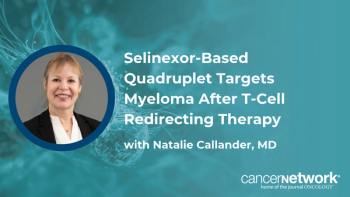
Natalie S. Callander, MD, discussed the rationale for combining selinexor, carfilzomib, subcutaneous isatuximab, and dexamethasone in relapsed/refractory myeloma.
Advertisement
Advertisement
Trending on CancerNetwork
1
Sequencing Bispecifics and CAR T-Cell Therapy in Myeloma and AL Amyloidosis
2
Novel Cancer Vaccine Plus Temozolomide Miss Primary End Point in Glioblastoma
3
Early Treatment Support and Real-World Care Gaps
4
FDA Approves Atezolizumab/Chemo for Stage III dMMR Colon Cancer
5