Now Playing
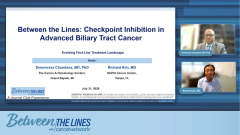
The faculty open the Between the Lines discussion by framing why advanced biliary tract cancer (BTC) remains a difficult-to-treat malignancy with rising incidence.
The faculty open the Between the Lines discussion by framing why advanced biliary tract cancer (BTC) remains a difficult-to-treat malignancy with rising incidence. They note that BTC accounts for less than 1% of cancers worldwide and that tumors arise from the intrahepatic bile ducts, extrahepatic bile ducts, and gallbladder, with substantial anatomic and molecular heterogeneity. The panel explains that most biliary tumors have an immune-suppressed or immune-excluded microenvironment, which limits the activity of single-agent PD-1 and PD-L1 blockade, and that actionable molecular subsets such as IDH1, FGFR2, and microsatellite instability-high are individually rare. The faculty then discuss statistics from KEYNOTE-966 and from ABC-02. They then outline the rationale for combining chemotherapy with PD-1/PD-L1 blockade, describing how gemcitabine and cisplatin can modulate immune activity (immunogenic cell death, reduced immunosuppression) and the combination offers a rationale for overcoming the immunosuppressive microenvironment.The segment closes by identifying the two phase 3, placebo-controlled trials that tested this hypothesis, TOPAZ-1 with durvalumab and KEYNOTE-966 with pembrolizumab, and by posing the practical questions of how clinicians sequence therapy at diagnosis and what barriers still limit broad adoption of first-line chemoimmunotherapy.