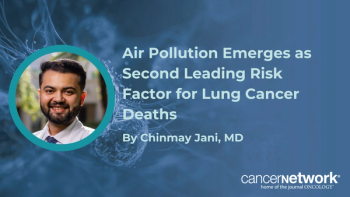
Chinmay Jani, MD, explains how air pollution and asbestos contribute to lung cancer deaths beyond tobacco.
Chinmay Jani, MD, discusses ASCO 2026 data on lung cancer trends in younger adults and why this group has been overlooked.
Research presented at the
Chinmay Jani, MD, a medical oncologist at Sylvester Comprehensive Cancer Center of the University of Miami Miller School of Medicine and lead investigator of this research, spoke with CancerNetwork® in a studio interview about what these trends show and why younger adults have been overlooked in lung cancer screening and research.
Transcript:
CancerNetwork: Your ASCO research looked at global and US trends in lung cancer among younger adults. What are those trends showing, and why has this group been overlooked?
Jani: Most importantly, so far, all our lung cancer screening guidelines, as well as the lung cancer scenario, have always revolved around [older] people who are smoking, and as we know, that is no [longer the whole] truth. After looking at the overall population in our previous study, we also wanted to see what the epidemiology and lung cancer burden look like in the younger population. In this study, which we presented this year at ASCO 2026, we looked at patients [younger] than 55, so roughly the 20 to 55 age group, and we were able to see how risk factors are constantly changing in this group.
Bringing it back to the tobacco story, in the younger population in 2023, only 65% to 70% of [men] had tobacco-associated lung cancer mortality, and in [women], it was only 35% to 40%. That means [more than half of the women] dying of lung cancer in the younger age group did not have any tobacco history.
We used this age cutoff because the current lung cancer screening guidelines, the USPSTF guidelines, mainly look at age, starting at 50, and smoking history…I would like to highlight that this is based on risk factor modeling, so it doesn’t include patient-level data directly; it’s modeled using the Global Burden of Disease database. But the majority of the population studied in this presentation would not be eligible for lung cancer screening. We are missing a big portion of the population who would not be able to get screened, and they might be diagnosed at a much later stage of their lung cancer.
Jani RT, Edwards K, Rauf A, Rodriguez E, Lopes G, Jani C. Lung cancer burden in AYAs: global and U.S trends. J Clin Oncol. 2026;44(suppl 16):8603. doi:10.1200/JCO.2026.44.16_suppl.8603