
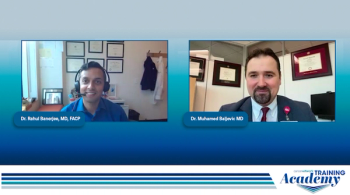
Dr. Rahul Banerjee and Dr. Muhamed Baljevic introduce the evolving role of cereblon E3 ligase modulators (CELMoDs) in relapsed/refractory multiple myeloma, highlighting emerging clinical evidence for mezigdomide.
Dr. Rahul Banerjee and Dr. Muhamed Baljevic discuss potential combination partners for mezigdomide and considerations for selecting treatment backbones in relapsed/refractory multiple myeloma.
Dr. Rahul Banerjee and Dr. Muhamed Baljevic explore the potential role of CELMoDs, particularly mezigdomide, in combination with or in sequence with T-cell-redirecting therapies, including bispecific antibodies and CAR T-cell therapy, in relapsed/refractory multiple myeloma.
Dr. Rahul Banerjee and Dr. Muhamed Baljevic discuss the clinical evidence needed to establish the role of CELMoDs in relapsed/refractory multiple myeloma, particularly when used before or after T-cell-redirecting therapies.
Dr. Rahul Banerjee and Dr. Muhamed Baljevic discuss a clinical scenario involving a 66-year-old man with relapsed/refractory multiple myeloma following two prior lines of therapy: daratumumab, lenalidomide, bortezomib, and dexamethasone (Dara-VRd) followed by daratumumab, pomalidomide, and dexamethasone (Dara-Pd).
Dr. Rahul Banerjee and Dr. Muhamed Baljevic discuss the safety profile and supportive care considerations associated with mezigdomide-based regimens in relapsed/refractory multiple myeloma.
Dr. Rahul Banerjee and Dr. Muhamed Baljevic discuss treatment considerations for a clinical scenario involving a 62-year-old man with quad-class-refractory multiple myeloma following four prior lines of therapy, including a BCMA-directed bispecific antibody.
Dr. Rahul Banerjee and Dr. Muhamed Baljevic discuss treatment selection and clinical trial considerations for patients with relapsed/refractory multiple myeloma following progression on a BCMA-directed bispecific antibody.