

Personal advice on how to manage living with RCC.

Your AI-Trained Oncology Knowledge Connection!
Personal advice on how to manage living with RCC.

GPRC5D may be a promising therapeutic pathway in the treatment of those with relapsed/refractory multiple myeloma, says Susan Bal, MD.

Data from the phase 1b MonumenTAL-2 trial support pomalidomide plus talquetamab as a promising treatment option in relapsed/refractory multiple myeloma, says Jeffrey Matous, MD.

Combining olverembatinib with blinatumomab appears to produce high complete molecular remission rates in patients with newly diagnosed, Philadelphia chromosome–positive acute lymphoblastic leukemia, says Elias Jabbour, MD.
Following a review of MonumenTAL-1, experts on multiple myeloma discuss the conclusions from the clinical trial and provide their impressions of the findings.
A panel of experts on multiple myeloma discuss dermatologic adverse effects seen in patients receiving talquetamab, including nail toxicities.

An overview of teclistamab in RRMM and the study methodology of using prophylactic tocilizumab to mitigate CRS associated with teclistamab
Sagar Lonial, MD, and Ellen Marin, PA-C, discuss cytokine release syndrome (CRS) and the strategy to manage CRS in their clinic.


Experts share future perspectives on the treatment and management of patients with RCC.
A patient's perspective on managing the side effects of treatment for advanced RCC.

Narjust Florez, MD, emphasizes the importance of treating CNS metastases in KRAS G12C mutated NSCLC, highlighting the promising but limited data on adagrasib’s CNS penetrance and intracranial response, as shown in the KRystal-1b study, making it a preferred option for patients with CNS metastases despite its associated side effects.
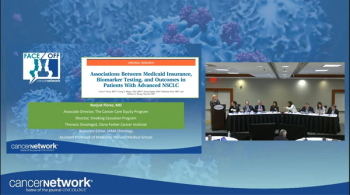
Dr. Florez leads the discussion on the association between Medicaid insurance, biomarker testing, and the outcomes in patients with advanced NSCLC.
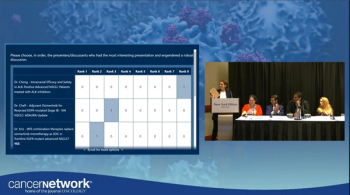
Conclusion of the discussion and award presentation.
Dr Narjust Florez discusses the higher incidence of hepatotoxicity with sotorasib as shown in real-world data, and suggests adagrasib as a preferable option for patients with pre-existing liver dysfunction or inflammation, highlighting the need to consider patient history and liver function when choosing KRAS inhibitors.
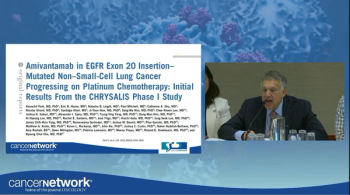
Dr. Herbst discusses the CHRYSALIS Phase 1 trial.


The expert panel concludes their discussion by examining the unmet needs and future for the treatment landscape in multiple myeloma.
Clinical insights on selecting the right bispecific antibody for the right patient and an overview of barriers seen in community practice.

Multiple myeloma specialists discuss patient education approaches regarding the management of oral toxicity stemming from talquetamab treatment and outline potential research approaches.
Following a review of oral adverse events, the expert panel discusses how to manage oral toxicities seen in patients with multiple myeloma who are treated with talquetamab.

A future phase 2 trial may compare anastrozole plus a CDK4/6 inhibitor and trastuzumab or pertuzumab with chemotherapy plus trastuzumab and pertuzumab in hormone receptor–positive, HER2-positive metastatic breast cancer.


Joshua Richter, MD, of Mount Sinai, and other hematologic cancer experts join CancerNetwork following the 2023 ASH Annual Meeting & Exposition to discuss the conference's most practice-changing data.

Ghayas C. Issa, MD, offers closing thoughts on genetic testing and targeted therapies for patients with relapsed/refractory acute myeloid leukemia.
Clinical insights on the evolving treatment landscape for patients with relapsed/refractory acute myeloid leukemia, with a focus on ongoing research and unmet needs.
Fixed-dose ibrutinib plus venetoclax produces limited second malignancies among patients with chronic lymphocytic leukemia, says Paolo Ghia, MD, PhD.