

Jennifer A. Ligibel, MD, discussed the complex link between weight loss and cancer risk, exploring data from bariatric surgery and the emerging role of GLP-1s.
Jennifer A. Ligibel, MD, discussed the complex link between weight loss and cancer risk, exploring data from bariatric surgery and the emerging role of GLP-1s.
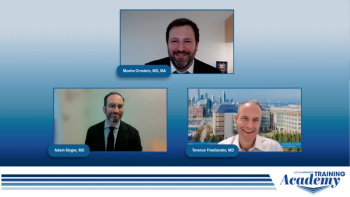
In this forward-looking segment on advanced renal cell carcinoma, Dr. Ornstein asks the panel to consider how treatment decisions may evolve if newer combination therapies become available in the second-line setting. He introduces the potential role of lenvatinib combined with belzutifan and asks how this regimen might fit into clinical practice.

In this segment on advanced renal cell carcinoma, Dr. Ornstein asks how clinicians differentiate among VEGF receptor targeted therapies when selecting treatment for patients with slower disease progression after prior immunotherapy. He highlights the perception that different TKIs may vary in both efficacy and toxicity.

Reducing vein-to-vein time and expanding manufacturing capacity represent ongoing challenges to optimizing the use of cellular therapy across indications.
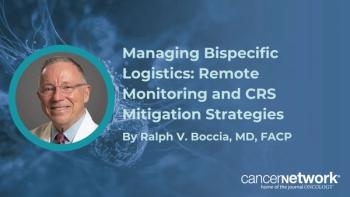
Ralph V. Boccia, MD, FACP, explained how his team utilizes patient monitoring kits to manage CRS and keep patients out of the hospital.
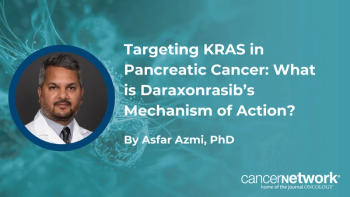
Asfar Azmi, PhD, discusses the tricomplex mechanism of daraxonrasib and its impact on overall survival for patients with pancreatic cancer.
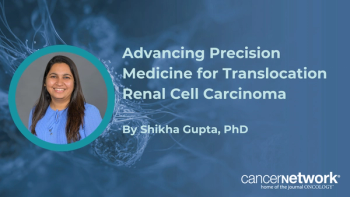
Shikha Gupta, PhD, discussed the mechanistic rationale for combining palbociclib and RMC-5552 in translocation renal cell carcinoma (tRCC).

Isaac Allen, PhD, analyzed how postdiagnostic lifestyle behaviors may affect oncological outcomes, including patient health-seeking behavior influences.

CancerNetwork, AJMC, and Pharmacy Times are producing The Bispecifics Network, where Ralph V. Boccia, MD, FACP, breaks down the importance of this initiative.
In this case-based segment on advanced renal cell carcinoma, Dr. Ornstein presents a patient with intermediate-risk disease who experienced progression after 14 months of frontline dual immune checkpoint inhibitor therapy. He highlights the importance of interpreting prior treatment response and clinical status when selecting second-line therapy.
In this case-based segment on advanced renal cell carcinoma, Dr. Ornstein presents a patient who progresses after frontline immunotherapy plus VEGF receptor targeted therapy, with prior tolerability challenges including hand-foot syndrome and diarrhea. He highlights the expanding range of second-line options, including HIF-2α inhibitors.

Molecular testing and multidisciplinary care play a vital role in treating rare sarcomas, according to Steven Bialick, DO.
Penetration of molecular testing for non–small cell lung cancer in the US is not at 100%, according to Lyudmila Bazhenova, MD, FASCO.

In this closing segment, the panel reflects on ongoing unmet needs in the first line management of EGFR mutated metastatic non-small cell lung cancer.
In this segment, the discussion returns to the theme of long term management in EGFR mutated metastatic non-small cell lung cancer.
According to Diane Simeone, MD, parallel investments in early screening and novel therapeutics can improve survival rates in pancreatic cancer.

Sara Tolaney, MD, MPH, explored whether elacestrant can improve RFS vs standard endocrine therapy in patients with high-risk, ER+/HER2– early breast cancer.
Diane Simeone, MD, discussed results from the RASolute 302 trial, which showed improved overall survival with daraxonrasib vs SOC in metastatic PDAC.

The final portion of the program shifts to case-based discussion, with the panel applying earlier debates to real-world clinical scenarios in relapsed/refractory DLBCL. The first case, a fit 58-year-old with early relapse, prompts consensus around rapid movement to CAR-T therapy with bridging strategies such as polatuzumab-based regimens, whereas the second case highlights challenges related to primary refractory disease and inconsistent caregiver support. The program concludes with closing remarks and a debate winner announcement, reinforcing the collaborative nature of evolving treatment strategies in LBCL.
Early trials exploring the efficacy of PD-1 blockade in Hodgkin lymphoma inspired the SWOG S1826 trial, which evaluated the agent with AVD in this population.
Surgical approach and adherence to endocrine therapy were predictors of locoregional recurrence in women diagnosed with breast cancer at age 40 or younger.
Minimal residual disease negativity may negate the need to wait 5 to 10 years for updated findings to inform treatment decision-making in multiple myeloma.