
Thought leaders from various institutions offered their shameless plug the 2023 ASCO Annual Meeting.
Thought leaders from various institutions offered their shameless plug the 2023 ASCO Annual Meeting.
Thought leaders from various institutions offered their take on the biggest winner that came out of the 2023 ASCO Annual Meeting.
In the setting of transplant-eligible newly diagnosed multiple myeloma, expert panelists consider how risk status may affect the selection of induction therapy.
Experts present the case of a 58-year-old patient with IgG kappa multiple myeloma and offer their initial impressions.
Experts on multiple myeloma discuss recent updates from the GRIFFIN trial on patients with transplant-eligible multiple myeloma.
A panel of clinical experts presents the case of a patient with high-risk multiple myeloma (MM) who underwent transplant.
Shared insight on the advent of quadruplet therapy regimens in the induction setting of transplant-eligible newly diagnosed multiple myeloma.
Clinical insights on treatment duration and the decision to place patients with newly diagnosed MM on maintenance therapy.
Thought leaders from various institutions offered their take on the trial the trial they think may need the most follow-up as a next step following the 2023 ASCO Annual Meeting.
Abdullah Khan, MBBS, explains the current data on bispecific T-cell engaging antibodies for the treatment of relapsed multiple myeloma.
Ashley Rosko, MD, presents the case of a 72-year-old woman with relapsed multiple myeloma for discussion.
Thought leaders from various institutions offered their take on the trial they think may lead to the next FDA approval following data that were presented at the 2023 ASCO Annual Meeting.
An overview of the various treatment options available for patients with MDS, with an emphasis on the importance of tailoring treatment choices based on risk profiles.
James K McCloskey, MD, Jamie L Koprivnikar, MD, and Christina Cho, MD discuss the diagnosis of myelodysplastic syndrome (MDS) and the importance of risk stratification in guiding treatment decisions.
The panel discusses how they would approach the treatment of a patient with relapsed/refractory MM who progresses on BCMA-targeting bispecifics.
The panel discusses the approach to step-up and treatment dosing for bispecifics in their respective health care systems.
Expert hematologist-oncologists discuss how they incorporate teclistamab in their clinical practice as well as variations in access to bispecifics and CAR T-cell therapy.
Experts on multiple myeloma provide insights on the management of hematological toxicities associated with bispecific antibodies.
Melissa Alsina, MD, presents the case of a 39-year-old patient with multiple myeloma who has disease progression after initially responding to teclistamab.
Panelists provide a broad-view perspective on established treatment pathways with bispecifics in multiple myeloma and the most prevalent challenges tied to this class of therapy.
Moderator Cesar Rodriguez, MD, spearheads a discussion on the current state of the multiple myeloma treatment paradigm with a focus on bispecifics in the multiply relapsed setting.
Thought leaders from various institutions offered their take on the most practice-changing trial that came out of the 2023 ASCO Annual Meeting.
Adverse effect management is a concern for clinicians when administering follicular lymphoma treatment, and the use of targeted pathways may help mitigate them.
Shared insight from Rafael Fonseca, MD, on data from MonumenTAL-1 and the use of talquetamab therapy in patients with relapsed/refractory multiple myeloma.
Expert perspectives from Joselle Cook, MBBS, on use of elranatamab in relapsed/refractory multiple myeloma based on data from the MagnetisMM-1 trial.
David Witt, MD, details the design and outcomes of the GRIFFIN study in newly diagnosed multiple myeloma.
Natalia Neparidze, MD, reviews the available induction treatment options for patients with newly diagnosed multiple myeloma (NDMM).
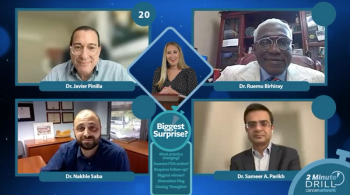
Thought leaders from various institutions offered their take on the biggest surprise that came out of the 2023 ASCO Annual Meeting.
Daniel G. Stover, MD, describes how findings from the phase 3 NATALEE trial may support expanding the portion of patients who receive CDK 4/6 inhibitors as a treatment for hormone receptor–positive, HER2-negative breast cancer.
Experts in multiple myeloma management review the role of CAR T-cell therapy in patients with relapsed/refractory disease.