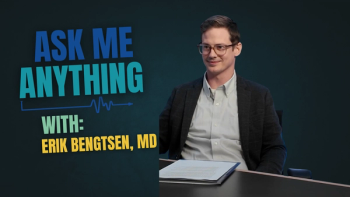
Erik Bengtsen, MD, discussed meaning-centered therapy at the bedside, framing psychiatry referrals, and a more humanistic approach to care.
Asked about the biggest misconception community providers hold about the referral process, Matthew J. Frigault, MD, clinical director of the Cellular Immunotherapy Program at Mass General Brigham Cancer Institute, emphasized that CAR T-cell therapy is a co-management strategy.
Asked about the biggest misconception community providers hold about the referral process, Matthew J. Frigault, MD, clinical director of the Cellular Immunotherapy Program at Mass General Brigham Cancer Institute, emphasized that CAR T-cell therapy is a co-management strategy. No single center could handle the volume of patients with multiple myeloma, he said, so true access depends on partnerships. Most centers are eager to advise on bridging so patients can receive it close to home.
Frigault also noted that recent FDA changes to the Risk Evaluation and Mitigation Strategy (REMS) program have shortened the time patients must remain near the treating center to 2 weeks and reduced the driving restriction from 8 weeks to 2 weeks. Patients who are doing well can now return home rather than relocating for a month. His center is also building a survivorship program addressing cancer screening, cardiac health, and endocrine health for patients doing well years after treatment.
Adam D. Cohen, MD, director of Myeloma Immunotherapy and professor of medicine at the Hospital of the University of Pennsylvania, described a myeloma survivorship clinic as an exciting new concept, one more familiar in Hodgkin lymphoma, and a sign that clinicians may be curing a proportion of patients.
Looking ahead, Frigault highlighted dual-targeting CAR T-cell products, including BCMA/CD19 and BCMA/GPRC5D constructs; first-line trials comparing CAR T-cell therapy with autologous stem cell transplant; in vivo CAR T-cell approaches that use an infused viral vector or mRNA to generate CAR T cells within the patient; and combinations of T-cell engagers with CAR T-cell therapy. The next challenge, both experts agree, will be deciding which option to use and when.