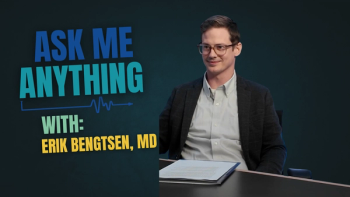
Erik Bengtsen, MD, described what sets psycho-oncology apart and how clinicians can open conversations on body image and sexual health.
Erik Bengtsen, MD, discussed meaning-centered therapy at the bedside, framing psychiatry referrals, and a more humanistic approach to care.
Erik Bengtsen, MD, an assistant attending psychiatrist and assistant director of the Consultation-Liaison Psychiatry Training Program at Memorial Sloan Kettering Cancer Center, discussed bedside meaning-centered therapy, how to frame a psychiatry referral, and what psycho-oncology has taught him to unlearn, in CancerNetwork’s® Ask Me Anything series.
Bengtsen described meaning-centered psychotherapy, developed at Memorial Sloan Kettering by William Breitbart, MD, to address existential distress by helping patients identify sources of meaning, such as family, faith, community, the arts, or their legacy. At the bedside, he said, the manualized course is abbreviated and meets patients where they are. He also shared how he reframes referrals for patients who worry that a psychiatry consult implies they are “crazy,” focusing instead on sleep, recovery, energy, and the stress of treatment. Finally, he reflected on moving beyond the rigid boundaries of classical psychiatry training toward a more humanistic presence with patients and families.
Bengtsen: Meaning-centered therapy was developed by one of our psychiatrists, Bill Breitbart, specifically to deal with some of the existential distress that can come up with cancer in a limited time frame. It asks what keeps us going in the face of suffering or pain, and it tries to find each individual person’s meaning, whether that’s connection to family, community, faith, or the arts, or their legacy and what they’ve contributed as a teacher or an engineer, and what they’ve really been proud of. It also looks at what strengths they’re modeling, even with loss of functioning or declining day-to-day functioning. Meaning-centered therapy at the bedside in the hospital will be abbreviated, picking up wherever the patient is. We’re not able to do a 6-week course and go through this manualized treatment chapter by chapter, so we just jump in where the patient is at.
Bengtsen: We’ve been called to the bedside, or a patient comes to see us in the outpatient clinic, and they’re quite upset that psychiatry was called. It’s the classic, ‘I’m not crazy. Who said I was crazy?’ I always try to tell patients that we see people who are dealing with different levels of stress from cancer and treatments. We commonly talk about things like, ‘How can we help you get enough sleep so you can get your strength for the next treatment? How can we help you recover from surgery better, whether that’s having more energy during the day?’ We also ask about the most common things we see: depression or anxiety secondary to this cancer journey.
Bengtsen: In classical psychiatry training, we have to learn a lot about setting firm boundaries and a very defined framework in psychotherapy, medication management, and how we relate to patients. In the cancer setting, we have to be more humanistic. We’re going to use ourselves as humans as we talk with the family of somebody in the ICU or as we deal with a patient. There’s this old-fashioned rule of no self-disclosing and no touching, but it’s OK to put a hand on the shoulder of a patient who’s in a lot of pain. As part of our physical exam, we also have to check for any arm stiffness or rigidity, since that’s an [adverse] effect of some of our medications too. We have to be more humanistic and be ourselves in the room to really connect with people who are suffering.
1. Vignette question: suicidality in a terminally ill… [discussion thread]. Reddit, r/Psychiatry. Accessed October 13, 2026. https://tinyurl.com/27h5jktv
2. Grassi L, Caruso R, Riba MB, et al. Anxiety and depression in adult cancer patients: ESMO Clinical Practice Guideline. ESMO Open. 2023;8(2):101155. doi:10.1016/j.esmoop.2023.101155