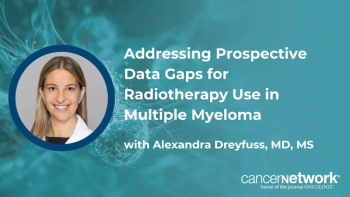
Alexandra Dreyfuss, MD, MS, explains why CAR T and bispecific populations are her priority for prospective radiotherapy studies in multiple myeloma.
Leah Katz, MD, MPH, discusses long-term IDEA trial data on omitting radiation and why endocrine therapy tolerance matters in this decision.
In an interview with CancerNetwork® at the
The trial enrolled 200 postmenopausal patients aged 50 to 69 years with biologically favorable, stage I, estrogen receptor–positive, HER2-negative breast cancer and a 21-gene recurrence score of 18 or lower who received endocrine therapy without radiotherapy after breast-conserving surgery. At a median follow-up of 7.93 years, freedom from recurrence was 99% at 5 years and 94% at 8 years, and most ipsilateral breast events occurred after 5 years.
Katz called omission a great option for carefully selected, well-informed patients, but cautioned that endocrine therapy can be difficult to tolerate and that radiation still offers an incremental reduction in local recurrence risk.
Katz: That’s a great question, and I do mention this in my talk. In very carefully selected, well-informed patients, it is a great option. However, there are 2 caveats that get lost in the conversation around this. The first is that endocrine therapy is very hard for women to tolerate. Omitting radiation relies on women taking a daily pill for 5 years, and to be honest, some people have intolerable [adverse] effects. Once we know that a person is going to have intolerable [adverse] effects, the window for radiation efficacy has already closed. A lot of women say to me, “Can I try the pill, and if not, I’ll do the radiation?” It doesn’t work like that.
The other thing I’d say is that whole breast radiation can now be delivered very safely over 1 week. The prior narrative of radiation being very cumbersome, difficult, and painful is no longer the case. Our techniques have gotten so good, and our fractionation schedules have gotten so short.
That’s a long-winded way of saying it’s a great option for women who are carefully selected and don’t need radiation. However, it doesn’t necessarily speak to the fact that radiation still offers an incremental benefit in risk reduction, even when it is safe and tolerable, from a local risk threshold, to omit it. Radiation still offers a benefit, and we see that in the older data, which show that in a very selected, low-risk population, radiation plus endocrine therapy still brought local recurrence down. It’s a great study, and I’m glad we have it. However, we need to take these other things into account.
Jagsi R, Griffith K, Harris EER, et al. Long-term follow-up of a prospective multicenter trial of endocrine therapy without radiotherapy after breast-conserving surgery for biologically favorable stage I breast cancers in younger postmenopausal patients. Presented at: 2026 ASTRO Annual Meeting; September 26-30, 2026; Boston, MA. Abstract 354.