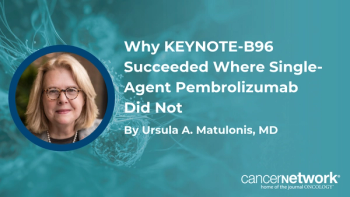
Ursula A. Matulonis, MD, broke down the trial design, backbone regimen, and preclinical rationale that she believes made KEYNOTE-B96 a positive study.
Ursula A. Matulonis, MD, surveyed the exploitable genetic changes driving the next wave of ovarian cancer trials, from CDK2 and WEE1 inhibitors to PARG inhibitors.
Antibody-drug conjugates (ADCs) have dominated recent ovarian cancer news, but Ursula A. Matulonis, MD, chief of the Division of Gynecologic Oncology at Dana-Farber Cancer Institute and professor of medicine at Harvard Medical School, described a trial landscape being reshaped on several fronts at once. Asked for a view of the field from her vantage point across cooperative group and Specialized Programs of Research Excellence (SPORE) trial leadership, she called it a very promising time and walked through the exploitable genetic changes now being targeted.
Cyclin E1 amplification came first. For those cancers, Matulonis pointed to CDK2 inhibitors, a number of which are in clinical trial testing, along with WEE1 inhibitors and WEE1 inhibitor combinations.
Next-generation sequencing has also made RAS alterations actionable, and Matulonis noted that this is particularly true in low-grade serous ovarian cancer (LGSOC). She cited the
Hormone-driven disease is a third front. In estrogen receptor (ER)–positive low-grade cancers—LGSOC and low-grade endometrioid ovarian cancer—Matulonis described CDK4/6 inhibitor combinations as very exciting. She framed the work as borrowing from the breast cancer field to learn how to use those agents in low-grade ovarian and ER-positive endometrial cancers.
Finally, she turned to DNA damage and repair. PARP inhibitors, she said, now hold a fixed role in ovarian cancer care, but other agents—PARG inhibitors and PARP1 inhibitors—are in testing to target cancers with genuine underlying DNA damage and repair defects.
Transcript:
CancerNetwork: From a bird's eye view, what does the trial landscape in ovarian cancer look like right now?
It is a very promising time. [There are] a few things. One, the expansion of different ADCs with active payloads such as topoisomerase, and being able to offer those drugs to patients who do not have folate receptor alpha (FRα) that's sufficient to get mirvetuximab [soravtansine-gynx (Elahere)], or potentially post-mirvetuximab if the FRα is present, or if HER2 is not present—I think is really exciting.
I think that really targeting other exploitable genetic changes within the cancer [is] also [an] exciting time. For example, [if a] cancer has cyclin E1 amplification, there are medications such as CDK2 inhibitors, a number of them in clinical trial testing right now. WEE1 inhibitors, and WEE1 inhibitor combinations are very exciting.
Sequencing—next-generation sequencing—can pick up RAS mutations, and that's certainly true of low-grade serous ovarian cancer. With the accelerated approval of avutometinib and defactinib, the RAF/MEK clamp plus a [focal adhesion kinase] inhibitor, for KRAS-mutated low-grade serous ovarian cancer—that phase 3 trial's results are still pending, but the initial phase 2 data in the KRAS-mutated patient population is quite exciting. But then also other RAS mutations that pop up, other KRAS mutations. Certainly, we've seen lots of exciting data in pancreatic cancer with the recent daraxonrasib [Rasonque] FDA approval.3 We're hoping in gynecologic [oncology] that this is infiltrating into our patient population.
Certainly, in ER–positive low-grade cancers—low-grade serous ovarian cancer, low-grade endometrioid ovarian cancer—the use of CDK4/6 inhibitor combinations [is] also very exciting. We're learning from the breast cancer world about how to use CDK4/6 inhibitors in our low-grade ovarian and low-grade ER–positive endometrial cancers as well.
Certainly also drugs that interact with DNA damage and repair. PARP inhibitors have a very fixed now role in how we take care of [patients with] ovarian cancer, but there are other drugs such as PARG inhibitors [and] PARP1 inhibitors that are being tested to really exploit ovarian cancers that have truly underlying DNA damage and repair problems.