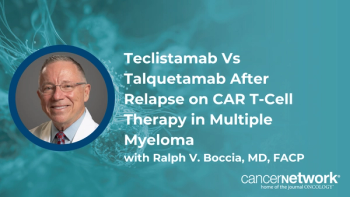
Ralph V. Boccia, MD, FACP, discussed how time since CAR T-cell therapy and toxicity profiles guide bispecific selection in relapsed multiple myeloma.
Ralph V. Boccia, MD, FACP, discussed stopping therapy in patients with deep, sustained responses and the move toward fixed-duration multiple myeloma care.
Ralph V. Boccia, MD, FACP, founder of The Center for Cancer and Blood Disorders, clinical associate professor at MedStar Georgetown University Hospital, and medical director of the International Oncology Network Clinical Research Program, discussed whether fixed-duration therapy could benefit patients with multiple myeloma who achieve rapid, deep responses, including minimal residual disease (MRD) negativity, on bispecific antibodies. Infection risk is a key concern with continuous T-cell–redirecting therapy and stopping treatment in the right patients could reduce that burden without compromising long-term outcomes. Boccia noted that oncology is moving toward fixed-duration approaches and that multiple myeloma is no exception.
He considers it very reasonable to stop treatment in patients with deep responses sustained for at least 1 to 2 years, pointing out that multiple myeloma is often relatively indolent until late lines of therapy and that patients can still enjoy treatment-free intervals even without MRD negativity. With MRD increasingly used as a clinical trial end point, he predicted that fixed-duration therapy will be offered to all patients within the next few years.
Today we’re moving toward fixed-duration therapies in everything we do, and [multiple] myeloma is no exception. The answer is yes for those who have very deep responses, and especially those who have deep, sustained responses, meaning at least a year, maybe 2 years, according to some of the studies. It’s very reasonable to stop therapy in those patients. Remember, [multiple] myeloma is often a relatively indolent disease, at least until you get to very late lines of therapy, and we’re talking about fourth-, fifth-, sixth-, or eighth-line therapy. Patients can relapse and still get nice treatment-free holidays, even if they weren’t MRD negative to begin with. If you look at the science now and where we’re going, we have begun to use MRD as an end point as opposed to response rates, and it’s going to be the norm, probably within the next 2 to 4 years, that everyone is offered fixed-duration therapy.