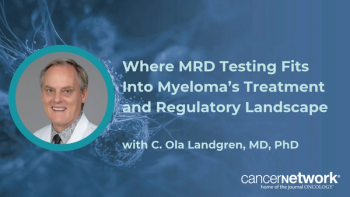
C. Ola Landgren, MD, PhD, discusses the FDA’s endorsement of MRD as an accelerated approval end point in multiple myeloma.
Natalie S. Callander, MD, discussed the rationale for combining selinexor, carfilzomib, subcutaneous isatuximab, and dexamethasone in relapsed/refractory myeloma.
Natalie S. Callander, MD, discussed the rationale for a quadruplet regimen being evaluated in patients with relapsed/refractory multiple myeloma in an interview with CancerNetwork® at the 2026 Big Ten Cancer Research Consortium Summit. Callander is professor of medicine in the Division of Hematology/Oncology at the University of Wisconsin School of Medicine and Public Health.
The phase 1b/2 BTCRC-MM21-528 trial (NCT07479979) is evaluating selinexor (Xpovio) in combination with carfilzomib (Kyprolis), subcutaneous isatuximab (Sarclisa) administered via an investigational device, and dexamethasone (SCID) in patients with relapsed and/or refractory multiple myeloma. The study began in May 2026 and enrollment is ongoing.1 Isatuximab in the trial is given through an on-body injector (OBI). The
Callander is also director of the Myeloma Clinical Program at the University of Wisconsin Carbone Cancer Center.
Transcript:
Callander: What has happened in the past 30 years in multiple myeloma has really been a revolution in therapeutic options. We did not have anything for many years. If you go back to 1960, we had melphalan and a drug called cyclophosphamide, and we had nothing more for almost 40 years after that. In terms of innovation, stem cell transplantation came around in the 1990s, but it was the serendipitous discovery of thalidomide [Thalomid] in the late 1990s that broke things open. Particularly in the last 15 years, we have had the development of proteasome inhibitors such as bortezomib [Velcade] and carfilzomib, and of other IMiD [immunomodulatory] drugs like lenalidomide [Revlimid] and pomalidomide [Pomalyst]. A very important approach has been to target a receptor called CD38. CD38 is found on B cells, T cells, and natural killer cells, and it is quite important in the function of these cells. It matters not only for communication with other cells; it ends up being important in antibody production for B cells.
Back in the early 2000s, there was drug development targeting this, with competing products. One product that was developed was daratumumab [Darzalex]; the other was isatuximab. Isatuximab fell by the wayside to a certain extent because it did not have a subcutaneous formulation. It only had a long [intravenous] infusion, even though there are in vivo and in vitro data that would suggest isatuximab is the superior CD38 antibody.
As I mentioned, we have great new therapies, and one of the newest frontiers is what are called T-cell redirecting therapies. Those are things like chimeric antigen receptor [CAR] T-cell therapy and bispecific engagers. Other cancers are treated with these as well. But once a patient relapses after those therapies, their options are quite limited. Some recent studies show that if you try to use conventional combinations of drugs, the average progression-free survival, the time before you need another therapy, is about 3 months. We really thought we needed to take some of our best drugs and put them together.
The exportin 1 inhibitor, selinexor, comes in here very importantly, because one of the theories about why patients become resistant to T-cell redirecting therapies is that their T cells are exhausted or not functioning properly. There is some interesting information that selinexor may be able to restore some of that function. So, in our minds, it made sense to take some very powerful drugs. We knew that some of these drugs had been given together before, say as doublets. But we thought putting all 4 of them together with the steroid would make logical sense to test, particularly in a population that has been thought to be very hard to treat once they relapse.