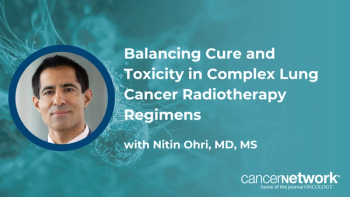
Nitin Ohri, MD, MS, discusses how his team manages toxicity and treatment tolerance as combination regimens grow more complex.
Paul Rubinstein, MD, discussed how cooperative groups are expanding CAR T and bispecific antibody research for patients with HIV-associated lymphoma.
In an interview with CancerNetwork® at the 2026 Big Ten Cancer Research Consortium (CRC) Summit, held October 2, 2026, at Big Ten Conference headquarters in Rosemont, Illinois, Paul Rubinstein, MD, a member of the Big Ten CRC, discussed the role of cooperative group research in studying chimeric antigen receptor (CAR) T-cell therapy and bispecific antibodies in patients with relapsed/refractory lymphoma who are living with HIV.
People living with HIV were excluded, based on their HIV status alone, from the trials that led to FDA approval of the currently available CD19-directed CAR T-cell products for relapsed/refractory B-cell lymphomas.1 In a matched cohort analysis conducted by the Center for International Blood and Marrow Transplant Research (CIBMTR) and the AIDS Malignancy Consortium (AMC), investigators prospectively collected data on 35 patients with HIV who received CD19-directed CAR T-cell therapy between August 2017 and November 2024. They compared these patients with a matched cohort of 135 patients without HIV. Cytokine release syndrome (CRS) of any grade occurred less often in the HIV-positive cohort (68.6% vs 82.2%; P = .04).¹ The AMC is now evaluating CAR T-cell therapy prospectively. The phase 1 AMC-112 trial (NCT05077527) is assessing the safety and feasibility of axicabtagene ciloleucel (Yescarta; axi-cel) in patients with well-controlled HIV and relapsed/refractory HIV-associated aggressive B-cell non-Hodgkin lymphoma.²
Rubinstein is an associate professor in the Division of Hematology and Oncology at the University of Illinois College of Medicine at the University of Illinois Chicago (UIC).
Transcript:
Rubinstein: Unfortunately, many trials from large cooperative groups do not include persons with HIV because there are so few. However, no one should be excluded from any clinical trial. This is why organizations like the AMC are so important. Everyone deserves to be on a clinical trial, and every group deserves to have all these newer therapies tested.
With CAR T, for example, we remove T cells from your blood and send them out for manufacturing, as we call it. They modify the T cells to attack the cancer, and [the cells] are reinfused into you at a later time. If you have HIV, the T cells removed from your blood are actually infected with HIV. For a long time, no one even wanted anyone with HIV to get these therapies. One of the trials, AMC-[112], is the first prospective study looking at CAR T in these patients with relapsed/refractory lymphoma. There have been retrospective studies done by the AMC and Stefan K. Barta, MD, MS, MRCPCUK, that showed it is the same; the efficacy is the same. Again, as I said before, for most therapies used in the non-HIV population, the efficacy is similar in the HIV population. We just need the time and the patience to prove the point.
That goes for all new therapies, including bispecifics. The AMC will have a bispecific antibody plus chemotherapy for upfront diffuse large B-cell lymphoma. The University of Illinois has a bispecific antibody for BCMA in combination with chemotherapy for plasmablastic lymphoma. There is a lot of work to do, and unfortunately, it sometimes takes time when the population is so small.