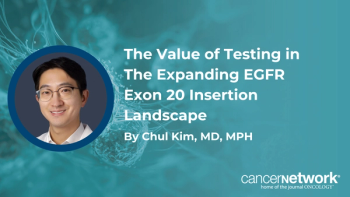
Clinicians must think a lot about how to make testing and novel treatment advances available for patients globally, according to Chul Kim, MD, MPH.
Dan Costin, MD, explains the rationale for testing a personalized mRNA vaccine after resection of high-risk stage I NSCLC.
An estimated 229,410 new cases of lung cancer will be diagnosed in the US in 2026, and it remains the leading cause of cancer death nationally.1 Among patients with early-stage, surgically resected non–small cell lung cancer (NSCLC), a subset have high-risk pathologic features that leave them at substantial risk of recurrence despite a successful operation. The phase 3 INTerpath-014 trial (NCT07513376) is evaluating the investigational personalized mRNA cancer vaccine intismeran autogene (V940), with or without pembrolizumab (Keytruda), in patients with completely resected, high-risk stage I NSCLC.2 The trial follows positive phase 3 data in resected high-risk melanoma, where intismeran autogene plus pembrolizumab improved recurrence-free and distant metastasis-free survival compared with pembrolizumab alone in the
Dan Costin, MD, director of the White Plains Hospital Center for Cancer Care, spoke with CancerNetwork®, whose center enrolled its first patient on INTerpath-014, about why this post-surgical setting is an important area of research and how high-risk pathology identifies patients who remain at risk despite successful resection.
Transcript:
CancerNetwork: What is the background or rationale for this phase 3 trial assessing a personalized mRNA cancer vaccine in patients with high-risk stage I NSCLC?
Costin: The rationale began about 6 years ago, when the rapid development of mRNA vaccines was shown to be feasible during the COVID-19 pandemic. The concept that this technology could also benefit cancer therapy has always been on the minds of cancer researchers and doctors for many years. The first big breakthrough came just a few weeks ago, when data for resected, high-risk melanoma showed dramatic benefits for patients.3
Lung cancer is a nemesis in our society. Over 200,000 men and women in our country are diagnosed with lung cancer every year.1 For early-stage resected lung cancer, a certain percentage of patients are found to have small tumors with high-risk features that place them at substantial risk of recurring and dying, even after a successful surgery. About 10% to 30% of these smaller tumors have high-risk features, and up to a third of those patients may end up dying from their cancer. We’re probably talking about 20,000 men and women a year in this group, and right now, we don’t have any additional treatment to offer them.
Stage I NSCLC is generally considered a surgical cure in many cases. What does “high-risk” mean in this context, and what pathologic or molecular features put resected stage I disease back in the recurrence conversation?
The high-risk features [include] histologic features such as visceral pleural invasion, lymphovascular invasion, and something called STAS, where the cancer has spread through air spaces. Do they have unique features like micropapillary features? Tumor size [matters too]; any tumor more than 2 centimeters is immediately higher risk, even though it’s still stage I. Some patients, because of comorbid conditions, may not tolerate the optimal surgery; if they have a sublobar or wedge resection instead of a lobectomy, that’s higher risk as well.
If, after surgery, we’re still picking up abnormal DNA, that can indicate microscopic cancer is still there, making the patient destined to recur. There are many different variables help us identify which patients are potentially in trouble and which patients are probably fine if we just observe them.