Jeffrey V. Matous, MD, explains why ramantamig’s MRD negativity rates are clinically significant in relapsed/refractory myeloma.
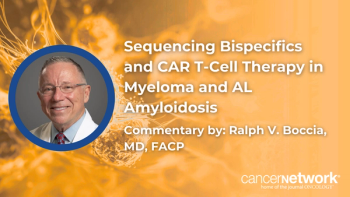
Ralph V. Boccia, MD, FACP, explained why CAR T-cell therapy followed by bispecific antibodies may be the preferred sequence at first relapse in multiple myeloma.
In a conversation with CancerNetwork®, Ralph V. Boccia, MD, FACP, founder of The Center for Cancer and Blood Disorders, clinical associate professor at MedStar Georgetown University Hospital, and medical director of the International Oncology Network Clinical Research Program, discussed how he decides between chimeric antigen receptor (CAR) T-cell therapy and bispecific antibodies for patients with multiple myeloma at first relapse, including those receiving lenalidomide (Revlimid) or daratumumab and hyaluronidase-fihj (Darzalex Faspro) plus lenalidomide maintenance. Boccia emphasized that treatment selection depends on many patient-specific factors, including individual needs, preferences, geography, and disease characteristics, and that shared decision-making remains central to every choice. From a scientific standpoint, however, he noted growing evidence that T-cell exhaustion following bispecific therapy may blunt the efficacy of subsequent CAR T-cell therapy. In contrast, a one-time CAR T-cell infusion may allow T cells to recover before later bispecific treatment. As a result, he explained that, ideally, CAR T-cell therapy would come first, with bispecifics reserved for the time of relapse.
This is always a challenge, for many reasons: patients are different, their needs are different, their desires are different, their geography is different, and their disease is different. There are a lot of factors that go into choosing. Everything today is made by shared decision-making, so that has to be a big part of it as well. If you look purely at the science, it’s now becoming clearer that, due to T-cell exhaustion after bispecifics, moving from bispecifics to CAR T is much less effective than the so-called one-and-done CAR T, where there’s an opportunity for T-cell rejuvenation that allows better efficacy for bispecifics afterward. Ideally, it would be CAR T followed by bispecifics at the time of relapse.