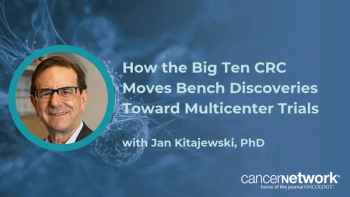
Jan Kitajewski, PhD, discussed how pooled expertise, pilot funding, and investigator support help move bench discoveries toward multicenter trials.
Veronika Bachanova, MD, PhD, discussed how the favorable safety profile of CAR natural killer cell therapies may come with trade-offs in persistence and response durability.
In an interview with CancerNetwork® at the 2026 Big Ten Cancer Research Consortium (CRC) Summit, Veronika Bachanova, MD, PhD, discussed the trade-offs between safety and durability of response with chimeric antigen receptor (CAR) natural killer (NK) cell therapies. Bachanova is a professor of medicine in the Division of Hematology, Oncology, and Transplantation at the University of Minnesota and co-leader of the Transplant and Cellular Therapy Program at the Masonic Cancer Center.
Unlike autologous CAR T-cell therapies, many investigational CAR NK cell products are derived from allogeneic sources, such as induced pluripotent stem cells (iPSCs), which allows them to be manufactured as off-the-shelf therapies. Bachanova coauthored the first-in-human phase 1 trial (NCT04245722) of FT596, an iPSC-derived, CD19-directed CAR NK cell therapy. In that trial, 10 of 86 patients with relapsed/refractory B-cell lymphoma experienced grade 1 or 2 cytokine release syndrome, and no cases of neurotoxicity or graft-versus-host disease were reported.
According to Bachanova, the trade-off for this safety profile may be limited persistence. That could shift how NK cell therapies are given, from a single infusion toward repeated dosing.
Transcript:
Bachanova: The safety profile is one of the biggest advantages of CAR NK cells, and that is exciting for the field because NK cells do not seem to trigger significant cytokine release syndrome and neurotoxicity. The incidence of these immune toxicities is low, or really absent, for several of the products. That is a huge advantage of NK cells.
The trade-off is that they may not be persistent. We are still learning whether the immediate presence of NK cells for maybe 2 to 3 weeks is enough to deliver an antitumor response. The use of NK cells could also be different from the use of CAR T cells. As opposed to “one and done,” we are learning that NK cells may need repeated infusions, either several days in a row or over a couple of cycles, to really expand their persistence and induce durable and deeper remissions.
In terms of the durability of responses, there is precedent from phase 1 and phase 2 studies that some responses are durable. That is perhaps a reflection of the depth of response while the cells are there. They are not persistent long term; this is not a living drug. NK cells are not likely to be detectable after several months of treatment, but they are certainly very effective and active soon after infusion to elicit that antitumor response.
Ghobadi A, Bachanova V, Patel K, et al. Induced pluripotent stem-cell-derived CD19-directed chimeric antigen receptor natural killer cells in B-cell lymphoma: a phase 1, first-in-human trial. Lancet. 2025;405(10473):127-136. doi:10.1016/S0140-6736(24)02462-0.