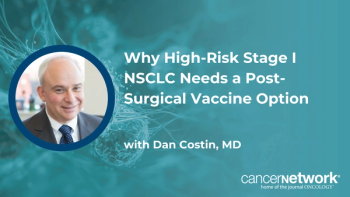
Dan Costin, MD, explains the rationale for testing a personalized mRNA vaccine after resection of high-risk stage I NSCLC.
Dan Costin, MD, describes counseling his first patient on a personalized mRNA vaccine vs observation in the INTerpath-014 trial.
White Plains Hospital recently enrolled its first patient on the phase 3 INTerpath-014 trial (NCT07513376), sending her tumor specimen to the vaccine manufacturer to develop a personalized mRNA vaccine tailored to her cancer. The trial is testing the investigational vaccine intismeran autogene (V940), with or without pembrolizumab (Keytruda), against placebo in patients with completely resected, high-risk stage I non–small cell lung cancer (NSCLC).2
Dan Costin, MD, director of the White Plains Hospital Center for Cancer Care, spoke with CancerNetwork® about what it was like enrolling that first patient and how he explained what a personalized, tumor-specific vaccine means compared with more familiar approaches like observation alone.
Transcript:
CancerNetwork: What was it like enrolling your first patient on this trial? What conversation did you have with her about what a personalized tumor-specific vaccine actually means compared with more familiar adjuvant options?
Costin: The first patient we enrolled was a perfect example of someone doing all the right things. She was getting her screening CT scans; everything she did was perfect. Then, lo and behold, there was a tumor. The tumor was still relatively small. There was no evidence of spread. She went on to have surgery, which went very well, [with] no metastatic disease to the lymph nodes; [it was] early stage. However, she had some of these high-risk factors. Even though this was picked up early, and even though we call this stage one, she was at high risk.
The first thing was explaining that yes, everything she did was perfect, this was picked up early, this is stage I, but not all patients with stage I disease are equivalent. The nuances of which patients are high risk vs not are really left to the medical oncologist [along with] understanding that having the tumor taken out doesn’t put you at a 100% chance that you’re cured. We can stratify and give patients an idea that maybe there’s a 20% risk, or a 30% risk, or if we’re lucky, maybe as low as 5% or 10%. That allows patients to think about whether that’s a risk they’re okay with, or whether they want to consider a clinical study, because right now we don’t have a standard treatment that could potentially reduce that risk.
This is a phase 3 study, which is good and bad news for patients. The good news is that it’s already gone through phase 1 and phase 2, so from a safety standpoint, we feel very good that this is a safe treatment. The bad news is that we still have to prove it’s better than our standard, which, right now, is to sit tight and, if there’s a recurrence, to treat and accept that maybe 20% or 30% of our patients may recur and potentially die from cancer.
This study has 3 arms. One is an open-label arm, where the patient will get immunotherapy [with] pembrolizumab plus the vaccine. Another arm gives either the vaccine or placebo without immunotherapy, and one arm is placebo alone. There’s a one-in-3 chance a patient will just get placebo because the standard of care right now is essentially doing nothing. Sometimes, it’s a process to help patients understand that if they don’t go on the study, they’re effectively getting placebo anyway, since that’s the choice not to participate.
This particular patient was very well educated, asked terrific questions, and was very motivated, both for herself and because she wanted to do something to help future patients. Her motivation was dual.
A clinical trial of adjuvant intismeran (V940) with or without pembrolizumab coformulated with berahyaluronidase alfa (MK-3475A) in high-risk stage I non-small cell lung cancer (V940-014) (INTerpath-014). ClinicalTrials.gov. Updated October 1, 2026. Accessed October 2, 2026. https://tinyurl.com/mp4sjkk7